
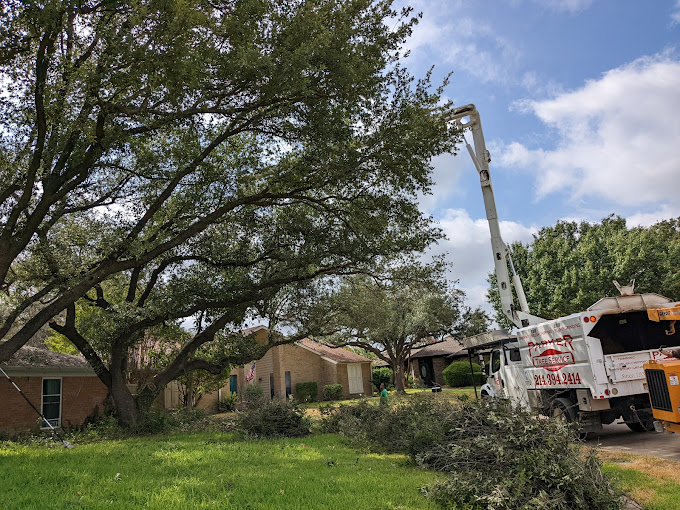
Expert Tree Removal Services for Clean Property Lines
North Texas property owners know how fast trees grow along fences and easements. One season your property line looks tidy, and by the next, branches are hanging over the neighbor’s driveway, roots are lifting the fence, and city code notices start showing up. In Plano, where mature trees are a major selling point for homes and commercial properties, poorly managed growth along property lines can quickly lead to disputes, safety concerns, and unexpected expenses.
A recent survey of municipal complaints in Collin County found that tree and vegetation issues are among the most common neighbor disputes, often tied to overhanging limbs, blocked sightlines, or fallen branches after storms. Add in our clay soils, high winds, and severe storm cycles, and it’s clear that clean, well-managed property lines are not just about appearance—they’re about safety, liability, and long-term value.
This guide walks Plano homeowners, HOAs, and commercial property managers through how expert tree removal, trimming, and care can protect property lines. You’ll learn how to spot boundary risks early, what professional services are available, and how Parker Tree Service approaches safe, code-compliant work that keeps your lines clean without sacrificing the health and beauty of your trees.
Key Insight: Clean property lines are the result of ongoing, expert tree care—strategic removals, precise pruning, and proactive health management—not just one-time cutting.
Why Property Line Trees Become a Problem in Plano
Property line trees often start as an asset: shade along a fence, privacy between homes, or a natural buffer between commercial lots. Over time, though, North Texas conditions can turn those assets into liabilities.
Plano’s expansive growth means homes and businesses sit closer together than they did decades ago. Large oaks, pecans, elms, and hackberries that once had room to spread now lean over roofs, fences, and driveways. Our heavy clay soils and shallow root systems compound the issue, especially after wet springs followed by dry, cracking summers.
Common property line problems we see across Plano include:
- Branches growing over a neighbor’s roof or pool
- Roots pushing up fences, sidewalks, and retaining walls
- Trees planted too close to property corners blocking visibility
- Dead or diseased trees at the boundary posing a fall hazard
One recent example: a Plano homeowner in an older neighborhood near Legacy Drive called us after a strong windstorm. A large, declining elm on the property line had dropped a massive limb across both yards, damaging a shared fence and narrowly missing a vehicle. Our team provided Emergency Tree Removal, then performed a full tree risk assessment along the property line to identify and remove other hazardous limbs before the next storm.
“Most property line tree problems are predictable once you know what to look for.” — Certified Arborist, Parker Tree Service
By understanding how local conditions affect property line trees, Plano owners can make smart decisions about whether to prune, treat, or remove trees to keep boundaries safe and clean.
Strategic Tree Removal vs. Smart Pruning Along Property Lines
Not every problematic tree along a boundary needs to be cut down. In many cases, skilled pruning and targeted health care can resolve conflicts and preserve valuable shade. The key is knowing when a Tree Removal Service is the safest option and when a Tree Pruning Service is enough.
When Removal Is the Best Option
Tree removal is usually recommended when:
- The tree is dead or in advanced decline
- Structural defects (cracks, cavities, severe lean) create a high failure risk
- Roots are causing ongoing damage to foundations, driveways, or underground utilities
- The tree species is invasive or notoriously brittle (e.g., some fast-growing ornamentals)
- There’s significant decay at the base or major limbs overhanging neighboring property
We recently worked with a Plano HOA where several aging hackberries lined the back property line of multiple homes. After a detailed inspection, our ISA Certified Arborist determined that three trees had extensive trunk decay and posed a high risk of failure. Our crew performed controlled removals, then followed up with Stump Grinding to prevent regrowth and root trip hazards along the shared fence.
When Pruning and Reduction Are Better
In other cases, expert pruning can restore clearance and reduce risk while preserving the tree:
- Crown reduction to lower height and weight
- Crown thinning to reduce wind resistance
- Clearance pruning to keep branches off roofs, fences, and neighboring yards
A business owner off Preston Road had a large live oak encroaching on an adjacent parking lot. Instead of removing a healthy, well-placed tree, we recommended selective Professional Tree Trimming and crown reduction. The result: improved clearance, reduced liability, and preserved shade for customers.
CALLOUT: The right decision isn’t “cut it or keep it”—it’s “what level of care will keep this tree safe, healthy, and within your property line obligations?”
Safety, Liability, and the Value of Professional Removal
Tree work near property lines is rarely just about aesthetics. It’s tied directly to safety and legal responsibility. In dense neighborhoods across Plano, a falling limb doesn’t just hit your yard—it often hits a neighbor’s roof, fence, or vehicle.
Why Professional Removal Matters
DIY cutting may seem tempting, but boundary trees add complexity:
- Limited drop zones near fences, sheds, and AC units
- Overhanging limbs above neighboring structures
- Power lines running along rear property lines and alleys
- Shared access with neighbors and HOAs
Professionals use rigging systems, cranes, and advanced cutting techniques to lower sections safely in tight spaces. At Parker Tree Service, our crews are trained to ANSI Z133 safety standards and follow ISA Best Management Practices for pruning and removal.
A Plano client near Coit Road learned this the hard way. A neighbor attempted to cut a large limb themselves. The branch swung unexpectedly, tearing down part of the fence and damaging both yards. The situation escalated into a dispute and insurance claim. When we were called in, we completed the remaining removals safely, documented the condition of the trees, and provided a report to help both parties and their insurers understand the risk that had existed.
“Tree work at property lines is as much about managing risk and relationships as it is about saws and ropes.” — Parker Tree Service Operations Manager
Cost, Risk, and Professional vs. DIY
Below is a simplified comparison of approaches many Plano property owners weigh:
| Approach | Upfront Cost (Plano Typical) | Risk Level | Long-Term Outcome |
|---|---|---|---|
| DIY cutting with ladder | Low | Very High (injury, damage) | Often incomplete, may worsen structure |
| Handyman / non-tree contractor | Low–Medium | High | Limited knowledge, liability concerns |
| Professional tree service | Medium | Low | Safe, code-compliant, insured |
| ISA Certified Arborist-led team | Medium–High | Lowest | Strategic, health-focused decisions |
When property lines and neighbor assets are involved, the lowest-risk option is almost always a qualified, insured tree company with an arborist overseeing the work.
Handling Emergencies: Storm Damage and Fallen Trees on Property Lines
North Texas storms don’t respect survey stakes. Straight-line winds, saturated soils, and the occasional ice event can bring down even healthy trees right across fences and shared boundaries. How those emergencies are handled can make the difference between a manageable situation and a costly, contentious one.
Fast Response Matters
After a storm, fallen trees blocking driveways, alleyways, or access to homes and businesses require urgent attention. Our Emergency Tree Service is structured for rapid deployment across Plano, especially in high-impact corridors where damage is common.
Typical emergency property line scenarios:
- A shared boundary tree uprooted and lying across two yards
- Large limbs through a shared fence into a neighbor’s pool
- Trees blocking alley access to garages or trash collection
- Uprooted trees entangled with overhead utility lines
In a recent storm near Independence Parkway, a large ash tree fell across the rear property line of two homes, crushing fences and blocking alley access. Our crew arrived the same day to perform Fallen Tree Removal, working carefully to protect both properties. We coordinated with both owners, documented the damage, and left the site safe and accessible before dark.
Emergency vs. Planned Work
Not all urgent-looking situations are true emergencies. A professional arborist can help you decide whether immediate Storm Damage Tree Service is needed or if the tree can be stabilized and scheduled for non-emergency work at a lower cost.
| Situation | Service Type Recommended | Typical Priority |
|---|---|---|
| Tree on roof or vehicle | Emergency removal | Immediate |
| Tree blocking driveway or alley | Emergency removal | Same day |
| Cracked limb over neighbor’s yard | Priority, but scheduled | 1–3 days |
| Leaning but stable boundary tree | Planned risk reduction/removal | Within 1–2 weeks |
By distinguishing between true emergencies and high-priority but stable situations, you can manage costs while still protecting your property and neighbor relationships.
Beyond Removal: Stumps, Roots, and Long-Term Property Line Health
Cutting down a tree is only part of the story. What’s left behind—the stump and root system—can still impact your property line for years. That’s where services like Stump Grinding, soil care, and tree health management come in.
Why Address Stumps and Roots?
Left in place, stumps and roots can:
- Sprout new shoots, creating dense, unsightly growth along fences
- Attract pests like termites or wood borers
- Interfere with new fencing or landscaping
- Create tripping hazards in narrow side yards or along easements
Parker Tree Service often pairs Affordable Stump Removal with boundary tree removals. We grind stumps below grade, allowing for re-sodding, replanting, or fence replacement without obstruction. In tight Plano backyards, this can reclaim valuable usable space.
Supporting Remaining Trees Along the Line
Once problem trees are removed, the remaining trees along a property line often need support. Changes in wind exposure and soil conditions can stress previously sheltered trees.
Our arborists may recommend:
- Targeted Deep Root Fertilization to strengthen root systems
- Structural pruning to balance crowns exposed by neighboring removals
- Tree Disease Treatment and Tree Pest Control to prevent opportunistic infestations
- Soil conditioning to improve drainage in compacted, clay-heavy boundary zones
We worked with a Plano homeowner whose neighbor removed several large pines along their shared fence. The sudden change in wind exposure put extra stress on the homeowner’s remaining oaks. By combining Tree Root Care, fertilization, and selective pruning, we helped those oaks adapt, preventing future failures into the neighbor’s yard.
“Tree care doesn’t end when the chainsaw stops. The healthiest property lines are managed as living systems, not one-off projects.” — ISA Certified Arborist, Parker Tree Service
Planning Ahead: Tree Surveys, Mitigation, and Neighbor-Friendly Solutions
Proactive planning around property lines can prevent a lot of future conflict. Whether you’re a homeowner, developer, or commercial property manager in Plano, taking a strategic approach to trees at the boundary pays off.
Tree Surveys and Risk Assessments
For properties with multiple mature trees along fences or easements, a formal Tree Risk Assessment or tree survey can identify:
- Trees that pose immediate safety risks
- Species prone to breakage or disease in our climate
- Root systems encroaching on foundations, driveways, or utilities
- Opportunities to preserve high-value trees while removing problematic ones
Developers and HOAs often use tree surveys to comply with local regulations and to plan Tree Mitigation—balancing removals with preservation and new plantings.
Tree Mitigation and Preservation
Plano values its tree canopy. In many developments, mitigation plans are required when significant trees are removed. Our team helps property owners:
- Determine which boundary trees are worth preserving
- Design Tree Preservation Services to protect roots and soil during construction
- Plan appropriate replacement trees with less invasive root systems and better structure
For example, a commercial property near Plano’s business corridor needed to remove several hazardous trees along a rear property line shared with residential homes. We created a mitigation plan that included safer replacement species, proper spacing from fences and utilities, and a long-term Tree Maintenance Services schedule. The result satisfied city requirements and maintained privacy for neighboring homes.
By approaching property line trees strategically—through surveys, mitigation, and neighbor-conscious planning—you protect your investment and reduce the chance of costly disputes down the road.
What This Means for Businesses in Plano, TX
For Plano businesses, clean property lines are about more than just curb appeal. They directly impact customer safety, brand image, and operational costs.
Retail centers along major corridors like Preston, Coit, and Spring Creek rely on trees for shade, comfort, and visual appeal. But overgrown branches crossing onto neighboring lots, hanging over parking spaces, or blocking signage can lead to:
- Liability claims from falling limbs
- Conflicts with adjacent property owners
- City code violations or insurance issues
- Negative impressions from customers and tenants
Proactive use of Tree Care Services and Tree Trimming Services Near Me helps businesses maintain clear sightlines, safe walkways, and visually consistent boundaries. Regular Tree Inspection and Tree Consultation with an arborist provide documentation that trees are being responsibly managed—a valuable asset in any dispute or insurance review.
For office parks and industrial properties, especially those backing up to residential neighborhoods, thoughtful boundary management is a sign of respect. Strategic Tree Crown Reduction, pruning, and selective removals can reduce leaf litter, prevent limb intrusion, and keep lighting and security cameras unobstructed, all while preserving the greenery tenants and employees appreciate.
Whether you manage a single storefront or a multi-building campus, a long-term partnership with a qualified tree service in Plano ensures that property line trees stay an asset, not a recurring problem.
Frequently Asked Questions
Q: How do I know if a tree on my property line needs to be removed or just pruned?
A: A professional evaluation is the best way to decide between Tree Removal and pruning. Our ISA Certified Arborist looks at the tree’s health, structural integrity, species, and proximity to structures and property lines. Signs that removal may be necessary include extensive decay, large dead limbs, severe lean, or major root damage. If the tree is generally healthy but encroaching on a neighbor’s property or structures, targeted Tree Pruning, crown reduction, or clearance pruning can often resolve the issue. In Plano, where storm risk is significant, we also consider wind exposure and soil conditions before recommending an approach.
Q: Who is responsible if a boundary tree falls into my neighbor’s yard in Plano?
A: Responsibility can depend on the tree’s condition before it failed. If a healthy tree is blown over by a severe storm, it’s often considered an “act of God,” and each property owner typically handles their own cleanup and repairs through their insurance. However, if a tree was clearly dead, diseased, or neglected, and you were aware of the hazard, you may be held responsible for resulting damages. Regular Tree Inspection and documented recommendations from a professional tree service help demonstrate that you’re managing your trees responsibly and can reduce liability concerns.
Q: How close to the property line can I plant a new tree without causing future problems?
A: The ideal distance depends on the mature size and root spread of the species. As a general rule in Plano, small ornamental trees should be at least 6–8 feet from the property line, medium trees 10–15 feet, and large canopy trees 20 feet or more away. Our arborists often recommend species with less aggressive roots for tight spaces and provide guidance on placement to avoid future conflicts with fences, driveways, and neighboring structures. A quick Tree Consultation before planting can prevent major issues 10–20 years down the road.
Q: Can you work on trees that are technically my neighbor’s but overhang my property?
A: Under Texas law, property owners generally have the right to trim branches that extend over their property line, as long as the work does not unreasonably harm the tree. However, working on a neighbor’s tree without coordination can strain relationships or create misunderstandings. We recommend discussing concerns with your neighbor and, when possible, arranging a shared visit from an Arborist Near Me. Parker Tree Service frequently mediates these situations, providing neutral, expert recommendations and performing pruning that protects both properties and the tree’s long-term health.
Q: What does a typical tree removal cost in Plano, especially along a tight property line?
A: Costs vary based on tree size, condition, access, and complexity. Boundary trees near fences, structures, or power lines typically require more careful rigging and labor than open-yard removals. While smaller removals may be a few hundred dollars, large, complex jobs can run higher. During your estimate, we assess all these factors and provide a clear, written proposal. Many Plano clients find that hiring a professional Tree Removal Near Me service is ultimately more cost-effective than dealing with potential damage, injury, or repeated partial work.
Q: How often should I have my property line trees inspected?
A: For most Plano homes and businesses, a professional inspection every 1–3 years is a good baseline, with more frequent checks for large, mature trees near structures or areas with heavy foot traffic. After major weather events—severe storms, ice, or prolonged droughts—it’s wise to schedule an additional inspection, especially if you notice new cracks, leaning, or dead branches. Regular assessments allow us to catch issues early and plan Tree Maintenance Services like pruning, cabling, fertilization, or removal before they become emergencies.
Q: Do you offer ongoing maintenance plans for property line trees?
A: Yes. Many Plano homeowners associations, commercial properties, and individual homeowners work with us on recurring maintenance plans. These typically include periodic Tree Pruning, health monitoring, soil and root care, and prioritized scheduling for storm response. A structured plan keeps property lines clean and safe year-round, spreads costs predictably over time, and reduces the likelihood of sudden, expensive emergency work.
Ready to Get Started?
Boundary trees don’t fix themselves. As Plano continues to grow and properties sit closer together, taking control of your property line tree care is one of the smartest investments you can make in safety and peace of mind.
Now is an ideal time to act—before the next storm cycle or growing season accelerates existing problems. Whether you’re dealing with an obviously hazardous tree, recurring fence damage, or just a nagging concern about overhanging limbs, a professional assessment from Parker Tree Service gives you clear answers and options. Our team can handle everything from strategic Tree Removal Service and Stump Grinding Service to precise pruning and long-term health care.
We’ve been serving Plano and surrounding North Texas communities for years, with ISA Certified Arborists, fully insured crews, and a reputation for treating every property as if it were our own. Schedule an inspection, walk your property lines with our arborist, and create a plan that keeps your boundaries clean, safe, and neighbor-friendly.
About Parker Tree Service
Parker Tree Service is a locally owned tree care company serving Plano, TX and the greater North Texas area. Our team includes ISA Certified Arborists and experienced crews specializing in Tree Care Services, removals, pruning, stump grinding, and advanced tree health care. With deep knowledge of local soils, weather patterns, and tree species, we help homeowners, HOAs, and businesses protect their properties and enhance their landscapes with safe, science-based care. Learn more about our services and philosophy at our website.