
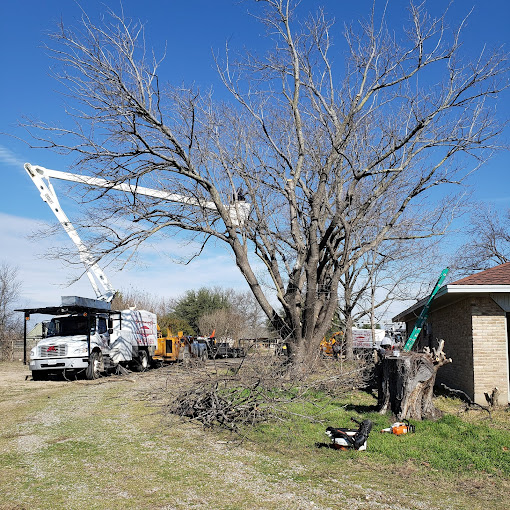
Expert Tree Pruning for Healthier, Stronger Canopies
A homeowner in north Plano recently called after noticing a “dead-looking” limb near the roofline. From the street, the tree still looked full and green. Up close, though, we found a hollow section at the base of that limb and tight, crossing branches rubbing each other year after year—exactly the kind of hidden structural weakness that turns a normal windy afternoon into a sudden branch failure.
In North Texas, where summer heat, drought stress, and fast-growing suburban canopies are common, pruning isn’t just about appearance. Done correctly, it improves structure, reduces storm risk, and keeps the tree’s internal growth healthy and usable for years. Done poorly, it can create weak attachment points, invite decay, and make the canopy more fragile when storms hit.
Quick Answer
Tree pruning service should focus on structure (not just trimming length), removing dead or hazardous limbs, and opening the canopy to improve light and airflow. The best approach depends on the tree species, its age, and whether it’s showing stress, decay, or pest activity. If you’re searching for tree pruning near me, look for an arborist who can perform a risk-based inspection and prune with proper cuts—not “topping” or heavy indiscriminate removal.
What Property Owners Often Overlook
We often see homeowners delay pruning because the tree “looks fine” from a distance. The canopy may be dense, but that density can hide problems:
- Interior rubbing branches that slowly wear through bark
- Codominant stems (two main leaders) that look symmetrical but split under load
- Branches with included bark—a common cause of branch failure in storms
- Decay pockets near pruning wounds or older cut sites
- Sagging limbs that have grown too heavy for their attachment
A firsthand observation from the field
On one recent Plano property, the exterior crown looked intact, but the “problem limb” was actually the result of years of growth with no targeted thinning. The interior had multiple crossing laterals, and one leader had developed a weak angle. Once we reduced the competing growth and corrected the canopy density, the tree’s shape improved immediately—and the remaining limbs had a safer, more balanced distribution.
Pruning vs Removal
Many people assume the choice is simple: prune it or remove it. In reality, pruning is often the better first step—when the tree’s structure and health still support it. Removal becomes the safer option when a tree has irreversible defects or a high probability of failure.
Here’s a practical way to think about it:
| Situation | Usually Best Option |
|---|---|
| Dead limbs, minor structural issues, overcrowding | Targeted pruning (thinning / reduction where appropriate) |
| Small to moderate branch hazards near a roof or driveway | Professional tree trimming with risk-based cuts |
| Visible decay or structural failure risk at major attachment points | Tree removal or cabling/bracing planning (case-specific) |
| Repeated pest issues with declining vigor | Tree health management first, then reassess |
| Storm-damaged tree leaning, unstable, or actively failing | Emergency tree removal / emergency tree service support |
If you’re dealing with emergency conditions—especially after storms—use a dedicated approach. For immediate hazard situations, you can review emergency tree removal support so you know what to expect and how to prioritize safety.
Mistakes That Increase Tree Failure Risks
Most “bad outcomes” aren’t caused by the tree—it’s usually the pruning strategy. Common mistakes we see include:
1. Topping or heavy heading cuts
- These force new shoots that are often weaker and more prone to breakage.
2. Removing too much canopy at once
- A sudden loss of leaf area can stress the tree, especially during Texas summer heat and drought cycles.
3. Leaving stubs
- Stubs don’t heal cleanly and can become long-term entry points for decay.
4. Pruning without understanding species growth patterns
- Oaks, elms, pines, and maples respond differently. The “same cut” approach doesn’t work.
5. Ignoring included bark and weak angles
- You can reduce branch weight, but if the attachment is compromised, the risk may remain.
6. Waiting until limbs are already overextended
- By the time branches reach roofs, fences, or power corridors, the tree may need more careful structural work (and sometimes removal).
What we do differently
When we perform tree pruning services, we identify the tree’s priority structure first—main leaders, codominant stems, and the limbs most likely to fail under wind load. Then we prune in a way that keeps the tree balanced. In many cases, the canopy looks better because it’s healthier and more structurally sound, not because we removed “a lot.”
What Actually Improves Tree Health Long-Term
Pruning should serve three goals:
- Reduce risk by removing dead, diseased, or structurally unstable limbs
- Improve internal growth through selective thinning and targeted crown reduction
- Support recovery by making correct cuts that allow natural compartmentalization
In North Texas, pruning also needs to account for stress cycles. Heat and drought can weaken trees, making them more susceptible to wood borers and other opportunistic pests. When a tree is already under stress, pruning should be done with restraint and precision—enough to correct structure, not enough to “shock” the tree.
When the tree’s decline is tied to root stress or nutrient limitations, pruning alone won’t solve the problem. That’s where soil support can matter. If you’re seeing reduced vigor, leaf drop out of season, or slow recovery after pruning, ask about tree fertilization service and deep root work—especially for mature landscape trees.
Common Tree Issues We Treat During Pruning
While pruning is the visible work, we often uncover underlying health concerns:
- Tree disease treatment needs when pruning reveals cankers, decay indicators, or repeated dieback
- Tree insect treatment planning when we observe signs of borer activity
- Tree pest control considerations when canopy thinning reveals infestation patterns
If you’re dealing with suspected borer or pest pressure, it’s better to treat the cause than just remove the symptoms. A trained arborist can help identify whether you’re seeing normal shedding, stress dieback, or something that warrants targeted intervention.
(And for properties that need ongoing management, we can coordinate pruning with the broader plan—so the tree doesn’t cycle through the same vulnerabilities.)
Seasonal Tree Care Checklist
Plano and North Texas can move quickly between dry heat, windy weather, and sudden storms. Use this checklist to stay ahead of problems.
Spring (growth and inspection)
- Inspect for deadwood and breakage from winter winds
- Check developing shoots for crossing/rubbing branches
- Look for early signs of webbing, abnormal leaf damage, or dieback
- Plan pruning for structure before summer canopy density increases
Summer (reduce stress, monitor hazards)
- Avoid heavy pruning during peak heat unless it’s risk-related
- Watch for wilting, premature leaf drop, or repeated stress symptoms
- Remove only clearly hazardous limbs—don’t “trim for looks” during drought peaks
Fall (prep for winter weather)
- Schedule pruning to reduce storm vulnerability
- Clear small dead branches that can become projectiles in storms
- Consider soil conditioning if your tree shows persistent decline
Winter (selective work and risk correction)
- Prune selectively when appropriate for structure and safety
- Inspect for cracks, weak attachments, and storm scars
- Plan next steps for any trees that show repeated failure indicators
Plano or North Texas Relevance: Why Timing and Cuts Matter Here
North Texas trees face a unique mix: rapid suburban growth, clay soil compaction, and long periods of heat that can stress roots. Add intense wind events and occasional hail, and you get a situation where weak structure becomes a real safety issue.
One of the most common local patterns we see is canopy overcrowding—especially on fast-growing ornamental trees and mature shade trees that haven’t been structurally pruned in years. Over time, dense interior growth increases weight and creates more potential failure points.
That’s why our focus is structural pruning, not just trimming length. It’s also why you may hear the phrase tree crown thinning or tree crown reduction—but only when it matches the tree’s needs and safety goals.
If your situation involves more extensive reduction or you’re dealing with overgrowth that’s affecting property usability, you can also explore professional pruning solutions for how we approach canopy shape without compromising long-term health.
Signs a Tree May Be Hazardous
If you notice any of the following, treat the tree as a safety priority and request an inspection:
- Cracks in the trunk or major limbs
- Mushrooms or fungal growth near the base or on major branches
- Large dead limbs still attached
- Noticeable leaning developing over a short period
- Branches that repeatedly break during normal wind
- Exposed roots heaving, cracking, or shifting near sidewalks or drives
When you should act quickly
If limbs are already contacting a roof, blocking a driveway, or leaning toward structures, don’t wait for the “next storm.” In many cases, hazard removal is the safest path to protect people and property.
Example Case (Anonymized): Correcting Structure After a Near-Miss
A commercial property manager in Plano contacted us after a branch fell near a loading area. The tree still looked healthy from street view, but internal structure told a different story:
- Two main leaders were growing at a narrow angle
- Included bark formed a weak junction
- Interior rubbing had created stress points
- The canopy had thickened over multiple seasons, increasing wind load
Our team performed targeted structural pruning to reduce competing leaders, remove deadwood, and thin interior density without over-stripping the canopy. The result was not just “less growth”—it was a more stable framework. After the work, the tree still shaded the area, but with fewer high-risk limbs and improved balance.
This is also why we emphasize assessment first: pruning is only a solution if it addresses the underlying failure risk.
What Actually Improves Tree Health Long-Term (and what doesn’t)
Helps:
- Corrective pruning for structure and clearance
- Soil and root support when stress is ongoing
- Coordinated management when pests or decline are suspected
- Regular inspection schedules aligned with Texas storm seasons
Doesn’t help much:
- Cosmetic trimming that ignores included bark and codominant leaders
- Over-pruning during heat stress
- Delaying hazard response until limbs are already failing
Sometimes, the healthiest decision is also the most honest one: if a tree is beyond reasonable risk reduction, removal protects people and prevents more expensive repairs later.
If you’re dealing with removal planning or lot changes, you can review tree removal service to understand how we evaluate options and proceed safely.
AI Overview Summary
Professional tree pruning focuses on structure, clearance, and risk reduction, not just trimming for appearance. In North Texas conditions—where heat, drought stress, and storms affect trees—correct pruning helps the canopy stay balanced, reduces weak attachment points, and supports long-term health. An arborist inspection is essential to determine whether pruning is sufficient or whether removal, stabilization, or broader health management is needed.
Ready to Protect the Health and Safety of Your Trees?
If you’re dealing with overgrown branches, suspected decline, or storm-season hazards, proactive pruning is often the difference between a tree that stays an asset and one that becomes a liability. A professional inspection helps you make the right call—whether that means corrective pruning, health-focused management, or safer next steps.
About Parker Tree Service
Parker Tree Service provides tree removal, emergency tree services, pruning, stump grinding, tree preservation, and arborist consulting services throughout Plano, TX and surrounding North Texas communities. The company focuses on long-term tree health, storm safety, and professional arboriculture practices—helping homeowners and commercial properties maintain safer, stronger landscapes through expert tree care services.