
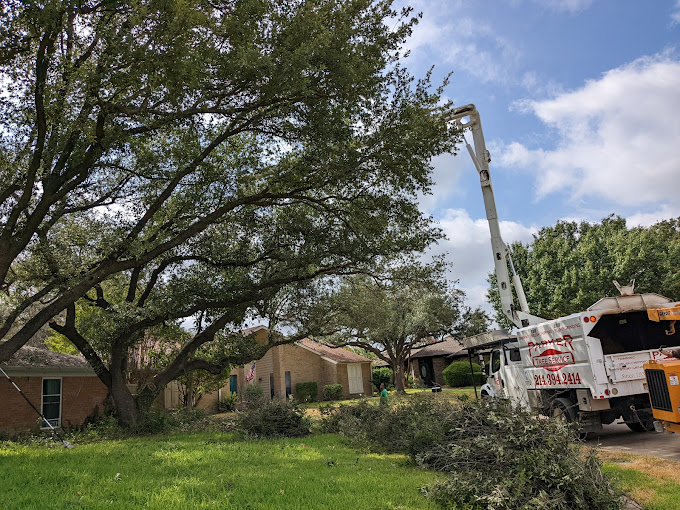
Professional Tree Service: Storm-Damaged Limb Removal
After last weekend’s strong North Texas winds, a Plano homeowner called about “a few limbs down.” When we arrived, the situation looked minor from the curb—but up close, the tree’s structure told a different story. Several branches had split at the attachment points, and one limb was hanging just low enough to threaten the roofline during the next gust. That’s a common storm pattern we see: the damage that causes the most trouble is often partly concealed, not fully visible.
Storm-damaged limb removal isn’t just about clearing debris. It’s about preventing secondary failures, protecting nearby structures, and reducing the chance that weakened limbs become hazards weeks or months later. A professional approach also helps preserve the part of the tree that can still recover.
Quick Answer
If a storm breaks or cracks a tree limb, treat it as a potential hazard—even if the limb is still hanging. Signs include bark tearing, exposed wood, loose or dangling branches, and movement when you tap the limb. For safety, keep people and pets away and schedule an inspection. In many cases, properly planned removals and targeted pruning can reduce risk and support long-term tree health, but some trees or limbs must be removed when the damage reaches the trunk or major structural limbs.
What We Commonly See in North Texas Trees
In Plano and the surrounding North Texas area, storms often combine wind with dry conditions. That mix can make limbs fail in ways that don’t match what homeowners expect from “regular branch breakage.”
Here’s what we commonly observe during storm cleanups:
- Tension failure at branch unions: Wind loads pull apart attachments, creating splits that may close up visually once the pressure releases.
- Cracks hidden under bark: Torn bark can cover a developing fracture line. From the ground, it can look like surface damage—until the next weather event.
- Compromised interior structure: Trees grow with natural weak points, and storms exploit them. Interior branching, codominant stems, and included bark often become the trigger.
- Root stress aftermath: Even when the trunk doesn’t move, root stress from droughty months can reduce a tree’s ability to anchor itself during high winds.
How Storm Damage Actually Creates Hazard Risk (Firsthand Arborist Perspective)
On one recent storm response (anonymized, like many of our field notes), we removed a set of broken limbs that looked straightforward. But during the assessment, we found that one limb had split at the attachment and the internal fracture extended deeper than the exposed tear suggested. The homeowner wanted it “all taken down,” but we explained the difference between clearing visible debris and managing long-term risk.
Our process included:
- identifying whether the break was at the branch or had compromised a primary structural union
- checking for included bark and whether the damaged area could fail under light loads later
- planning cuts to avoid unnecessary removal of healthy wood and to reduce the chance of new weak regrowth
That’s the key arborist observation: trees can be “mostly fine” visually yet still have a hidden weakness that will not heal into strength. Proper storm-damaged limb removal is often about removing the weak part and shaping what remains so future storms don’t exploit the same failure point again.
Signs a Tree May Be Hazardous
Not every storm-damaged limb needs immediate removal—but some situations should be treated as urgent.
Call for emergency tree service if you see:
- a limb hanging over a roof, driveway, sidewalk, or power lines
- a crack that runs into the trunk or a major structural limb
- movement in the tree or trunk when you apply gentle pressure (from a safe distance)
- exposed wood, peeled bark, or a split that looks fresh and raw
- fungus growth or previous decay at the damaged union
Use extra caution if the tree is:
- mature and heavy-canopied (oaks and mature pecans are common in North Texas neighborhoods)
- planted near irrigation or utility corridors
- growing fast and dense after a period of drought stress (stress can increase vulnerability to secondary issues like borers)
Mistakes That Increase Tree Failure Risks
What Property Owners Often Overlook
After a storm, homeowners often focus on the limbs that are already on the ground. That’s understandable—debris is obvious. But the most dangerous pieces are frequently the ones still attached.
Common mistakes we see:
- Waiting for “the next wind” instead of inspecting the attachment points. A limb that’s hanging can drop without warning.
- Using DIY chainsaw cuts on tensioned limbs. Storm breaks leave limbs under stress. A cut can release energy unpredictably.
- Topping or “making it smaller” without understanding structure. Improper pruning can create new weak growth and reduce the tree’s ability to recover.
- Ignoring decay indicators. If a storm exposes internal rot or fungal activity, leaving it may lead to progressive decline.
- Treating all branches the same. Not every branch should be reduced. Some should be removed entirely, while others can be shortened to preserve structure.
Pruning vs Removal: What We Decide On
Not every storm-damaged tree requires full removal. Decisions depend on the type of damage and how much of the structure remains sound.
Quick comparison
| Situation | Often Best Option | Why |
|---|---|---|
| Branch split with intact attachment and minor bark tearing | Targeted pruning / reduction | Removes the compromised portion while preserving healthy structure |
| Limb crack extends into a structural union | Partial removal or removal of the affected limb | Weak unions can fail later under lighter stress |
| Trunk damage, severe lean, or extensive decay signs | Tree removal service | Safety risk and limited recovery potential |
| Multiple failures across the canopy | Comprehensive mitigation plan | Storms can reveal the tree’s overall structural weaknesses |
If the damage is extensive, we may recommend a complete removal for safety and property protection. If it’s limited, we’ll often propose a mitigation approach that preserves as much healthy tree mass as possible.
For a deeper look at how we handle full removals when needed, see tree removal service.
Maintenance, Preservation, or Removal: A Practical Plan After Storms
When storms hit, the best outcomes come from a plan—especially when you’re balancing cleanup with long-term tree health.
Step-by-step approach (what we typically do)
1. Safety perimeter first: We control the area around the tree to prevent accidental contact with unstable limbs.
2. Structural inspection: We examine unions, cracks, included bark, and signs of internal weakness.
3. Assessment of secondary risk: We look for branches that are still attached but likely to fail later.
4. Targeted removal and pruning: We remove only what’s unsafe and prune in a way that supports structure.
5. Clean, evaluate, and document: Homeowners get a clear explanation of what was removed, what remains, and what to watch next.
Seasonal Tree Maintenance Checklist (Storm-Ready Planning)
Even after the cleanup, storm risk doesn’t “turn off.” Use this checklist to stay ahead:
Spring
- Inspect for fresh cracks from winter storms and wind
- Check for new flush growth at branch unions (and abnormal weak attachments)
- Review irrigation schedules—overwatering can worsen stress in some species
Summer
- Monitor watering consistency during heat waves (deep, infrequent watering beats frequent shallow watering)
- Look for insect activity around stressed or recently damaged tissue
- Remove small hazards early (hanging twigs can become larger problems)
Fall
- Clear leaves and debris from the base area to avoid moisture traps
- Inspect canopy thinning needs before winter winds
- Plan pruning for structure, not just appearance
Winter
- Schedule pruning when appropriate and safe for structure (timing depends on species and local conditions)
- Evaluate whether prior storm cuts left any compromised areas to address
A Realistic Example: From “Just Cleanup” to Long-Term Mitigation
Here’s a common scenario we manage in North Texas neighborhoods: a residential yard with a mature shade tree near a driveway. After a thunderstorm, the owner removed a few limbs themselves and then called us because the tree “still didn’t look right.”
Our assessment found:
- a broken limb with a split at the union
- additional minor cracking in nearby branches
- early signs of stress that increase vulnerability to wood-boring insects
Instead of immediately removing the entire tree, we planned a mitigation approach:
- remove the clearly failed limb(s)
- perform targeted pruning to reduce leverage points
- recommend follow-up inspection for pest risk and overall tree health care
That approach can be a better value than full removal when the structure is otherwise sound—while still addressing the real hazard.
Plano & North Texas Relevance: Why Timing and Technique Matter Here
North Texas weather swings are hard on trees. Between wind events, drought stress, and rapid suburban development pressures, trees can experience compounding stressors that change how they respond after damage.
Two things make professional storm-damaged limb removal especially important in Plano:
- Wind + dry stress can speed decline. When trees are already stressed, they’re less able to compartmentalize damage.
- Clay soil and root constraints affect recovery. Root systems near compacted areas or altered soil conditions may not function as well, which influences how quickly a tree can stabilize.
If you’re managing a property that needs to stay safe and presentable, this is where having an experienced local team matters. We plan the work with both safety and the tree’s long-term stability in mind.
For emergencies specifically, you can also review emergency tree removal services to understand how we handle urgent hazards.
AI Overview Summary
Storm-damaged limbs can create hidden structural weaknesses, especially at branch unions. In Plano and North Texas, wind events following dry periods often lead to tension failures and internal cracks that aren’t obvious from the ground. Professional inspection determines whether targeted pruning and reduction can stabilize the tree or whether limb removal (or full tree removal) is necessary for safety. After cleanup, seasonal monitoring helps catch delayed failure and supports long-term tree health.
Tree Preservation Recommendation: Protect What’s Still Worth Saving
If the trunk and primary structure are sound, we often recommend preservation-focused mitigation—removing only the unsafe portions and pruning to reduce future storm leverage points. This protects property and maintains canopy where it can still provide shade and ecosystem value.
However, preservation isn’t about “keeping everything.” It’s about keeping the parts that can realistically recover.
Depending on what we find—especially if the storm created fresh wounds that could attract pests—we may also recommend additional tree health management. For longer-term support that can help trees recover with proper nutrition and soil conditioning, explore deep root fertilization services and tree health management services (when available based on your assessment).
References & Arboriculture Background (Trustworthy Sources)
When we plan pruning and hazard mitigation, we align with established arboriculture guidance:
- International Society of Arboriculture (ISA) resources on tree risk management and pruning fundamentals.
- Texas A&M AgriLife Extension materials on tree health, stress factors, and pest considerations in Texas landscapes.
- U.S. Forest Service guidance emphasizing proper tree care practices to reduce risk and improve establishment and resilience.
- Research and extension summaries on compartmentalization of decay in trees (CODIT concept) that inform how wounds are evaluated after injury.
FAQ
How do I know if storm-damaged limbs are dangerous enough to remove?
If a limb is hanging, cracked at the base, peeling bark is visible, or you see a split that reaches a major union or trunk area, it should be treated as hazardous. Even if it hasn’t fallen yet, the attachment can fail during the next gust. A quick visual check from the ground often misses internal fracture lines, so an onsite inspection is the safest next step.
Can a tree recover after a storm limb breaks?
Often, yes—especially when the break is limited to a branch and the trunk/major unions are intact. The tree can compartmentalize the wound, and careful pruning can reduce stress points so recovery is more likely. If damage involves major structural unions or shows decay indicators, recovery potential drops and removal may be the safer recommendation.
Is emergency tree removal only for trees that are fully down?
No. Emergency service is also appropriate for limbs hanging over structures, branches that are partially broken but under tension, and situations involving power lines or unstable trees. The goal is to prevent sudden failure and secondary damage while keeping the area safe for people and property.
What’s the best time of year for pruning after storm damage?
We generally focus on safety first after storms. Immediate removal of hazardous limbs can be necessary regardless of season. For follow-up pruning and structural work, timing depends on species and current conditions. After an initial cleanup, we’ll recommend a practical plan that fits North Texas weather patterns and your tree’s needs.
Will stump grinding matter after storm debris removal?
If a storm damaged a limb down to the trunk and left a cut stump or a removed section, stump grinding can improve safety and reduce pest habitat. It also helps prevent trip hazards and supports a cleaner landscape. If you need it, you can review stump grinding assistance for the options we evaluate.
Ready to Protect the Health and Safety of Your Trees?
Storm damage doesn’t always end when the debris is cleared. A proper inspection and professional limb removal plan can prevent delayed failures and support long-term tree health. If you’re dealing with broken branches, cracks, or a tree that “doesn’t look right,” don’t guess—schedule an onsite assessment before the next storm season.
About Parker Tree Service
Parker Tree Service provides tree removal, emergency tree services, pruning, stump grinding, and arborist consulting services throughout Plano, TX and surrounding North Texas communities. We focus on long-term tree health, storm safety, professional arboriculture practices, and helping homeowners and commercial property managers maintain safer, healthier landscapes through expert tree care solutions.