
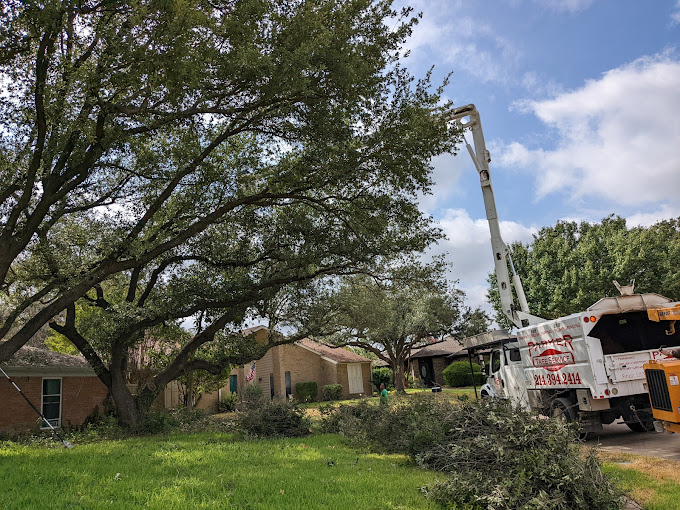
Tree Pruning for Wildlife-Friendly, Landscaped Canopies
Last summer, a Plano homeowner called us because their mature live oak looked “fine” from the street—full, green, and impressive. But when the family sat on the patio, they kept hearing a soft tapping inside the canopy. After a closer inspection, we found a combination of wildlife activity and structural stress: a few interior limbs were dead or dying back from the inside, and the crown had grown dense enough to trap moisture against the branch union. Those conditions don’t just affect appearance. They can increase the odds of branch failure in wind, and they can also slow down recovery after pruning—especially when pruning is done like “haircutting” instead of like an arborist.
For homeowners and commercial property managers in North Texas, the goal is simple: keep trees beautiful and safe while protecting habitat. The challenge is doing it in a way that supports tree health, not just curb appeal.
Quick Answer
Wildlife-friendly tree pruning focuses on targeted thinning and structural pruning—removing dead, diseased, crossing, or hazardous limbs while preserving healthy habitat features and keeping cuts where the tree can compartmentalize them. In Plano and across North Texas, pruning is also a storm-safety tool: thinning the crown reduces wind sail and helps dry the interior canopy, which can lower disease pressure. If a tree shows structural risk or pest-related decline, pruning alone may not be enough—our team may recommend targeted removals or a full tree removal service when the hazard can’t be mitigated safely.
Pruning for Wildlife-Friendly, Landscaped Canopies (What “Good” Looks Like)
When people hear “pruning,” they often picture trimming the ends of branches to shape the tree. From an arborist’s perspective, that approach can be harmful for two reasons:
1. Topping and heavy end-cutting can trigger vigorous, weak regrowth (often called “water sprouts” or “sucker growth”).
2. Over-thinning the wrong parts can expose the tree to stress—especially in our Texas heat and sun intensity.
Wildlife-friendly doesn’t mean “leave everything.” It means choose the right cuts and avoid unnecessary damage.
What we typically prune (and why)
A healthy canopy is more than leaves. It’s a living structure that manages weight, wind, and sunlight. In practical terms, wildlife-friendly pruning usually targets:
- Dead or dying limbs: These are often the safest to remove and the most valuable to wildlife when left intact if they’re truly healthy and stable. If they’re failing, they’re a safety risk.
- Crossing or rubbing branches: Rubbing creates wounds that invite decay and insects.
- Co-dominant stems with weak attachment: Some trees develop two leaders that look fine until wind loads them.
- Interior crowding: Reducing dense interior growth improves airflow and light penetration without stripping the entire canopy.
- Branches interfering with structures or access: Clearance pruning should be done with care to protect branch health and avoid creating weak stubs.
Wildlife and habitat: preserving without ignoring risk
Many homeowners want to keep “some character” in their trees—deadwood for insects, natural hollows, and layered canopy structure for birds. That’s reasonable. But here’s the key: habitat features only help wildlife when the tree is stable.
During an on-site assessment, we look for:
- Decay indicators at branch unions (soft wood, flaking bark, abnormal cavities)
- Loose attachments that can shed limbs
- Cracks along the grain that often appear after drought-stress followed by storms
If a cavity or dead limb is stable, we may recommend retaining it (when safe). If it’s unstable, we plan a removal that reduces risk while still maintaining overall canopy form.
Hand-in-hand with aesthetics
In North Texas landscapes, most trees are expected to do more than provide shade. They must also:
- frame windows and walkways,
- avoid constant leaf or limb cleanup,
- and stay storm-ready.
That’s why our pruning plan often includes crown thinning (reducing density) and crown raising (clearance under the canopy) rather than blanket “cut it back” trimming.
If you’re also dealing with overgrowth that has gone beyond typical trimming, you may want to review tree pruning services near me to understand how our team handles shaping and reduction with tree health in mind.
What Property Owners Often Overlook
This is the part I wish every homeowner could see the day we first walk the property.
We often see people delay pruning because the tree “still has plenty of leaves.” But many structural problems are hidden:
- Inside-the-crown dieback can occur without obvious external signs.
- Branch unions may have weak attachment that won’t reveal itself until wind load.
- Moisture trapped in dense canopies can increase the likelihood of fungal issues along branch collars.
- Pest activity doesn’t always show up immediately as visible damage—wood borers and other insects can quietly weaken limbs over time.
A firsthand observation we see frequently in North Texas
On several Plano properties, we’ve found that trees with heavy interior growth often develop small dead limbs near crowded branch unions. Homeowners notice them only after they fall or after a storm shakes loose small pieces. By that point, decay has already started. The lesson: pruning isn’t just seasonal beauty—it’s a risk management practice.
Mistakes That Increase Tree Failure Risks
If you want a safer canopy and a healthier tree, avoid these common mistakes.
1) “Shaping” by cutting branch ends only
End-cut pruning can create many weak shoots. Over time, those shoots add weight without improving structure.
2) Letting clearance become an accident
When branches grow into roofs, fences, or power lines, the temptation is to do quick fixes. Clearance pruning needs to be planned so the tree can heal properly—cuts should avoid leaving damaging stubs.
3) Ignoring insect and disease signals
If you’re seeing:
- holes in the trunk or branches,
- sawdust-like frass,
- bark cracking,
- or branch dieback in patterns,
…pruning alone won’t solve the underlying stress. In cases involving borers, the long-term plan may include targeted deep root fertilization services and soil conditioning to support recovery, along with appropriate pest and tree health management.
4) Pruning during the wrong window for the tree and the situation
Timing matters in Texas heat. A poorly timed pruning can stress some species more than others, and it can complicate healing.
5) Forgetting the stump and root zone after removals
When a tree is removed, the remaining stump and roots can still impact future landscaping and create trip hazards. If you’re moving toward removal, stump management matters. For example, many properties benefit from stump grinding service to keep the site safe and improve soil conditions for future planting.
Seasonal Tree Care Checklist (Plano & North Texas Friendly)
A good pruning plan is built around what the tree is doing biologically and what North Texas weather tends to do to stress levels.
Late winter to early spring (structure + safety)
- Inspect for deadwood, crossing limbs, and cracks.
- Prioritize structural pruning and crown thinning.
- If you’re planning wildlife-friendly pruning, coordinate around nesting activity.
Spring to early summer (growth management + targeted cleanup)
- Remove fresh dead limbs and any obvious storm breakage.
- Address localized pest pressure if you see branch dieback patterns.
- Avoid heavy pruning during peak heat when possible.
Summer (monitoring, not major cuts)
- Watch for signs of stress: wilting, unusual leaf drop, or rapid dieback.
- If you have a hazardous limb, don’t wait—storm damage can worsen quickly.
Fall (prep for winter wind loads)
- Focus on risk-based pruning and clearance.
- Reduce interior crowding so the canopy doesn’t hold excess moisture.
- Plan next steps for any trees that need deeper health support.
Pruning vs. Removal: When Each Is the Right Move
Not every problem is solved by pruning. Sometimes the correct recommendation is removal, especially when structural integrity is compromised.
Here’s a practical way to think about it:
| Situation | Pruning usually helps | Removal may be safer |
|---|
If you’re dealing with a hazardous limb right now
If a tree has become unsafe after wind or ice, you need a plan that prioritizes people and property. For immediate hazards, we support emergency response through emergency tree removal services—the goal is to stabilize the situation, remove risk, and prevent secondary damage.
For long-term safety and tree health, we also perform tree inspections and risk assessment as part of the decision-making process.
Our Experience Managing Trees in Texas Conditions
Texas weather doesn’t just “happen.” It shapes tree health.
- Drought stress weakens trees and can make them more vulnerable to insects.
- Heavy storms expose weak attachment points that were previously “good enough.”
- Clay soils and compacted ground can limit root function and recovery.
- Suburban development often changes drainage and soil depth around mature trees.
In the field, we often see decline accelerate after a dry period, especially in trees that already have internal crowding or old structural weaknesses. That’s why we don’t treat pruning as an isolated event. It’s one component of a broader health strategy.
When deep root support helps
If your tree is struggling, improving soil conditioning can be part of getting it back on track. Our approach may include deep root fertilization services—not as a quick fix, but as a way to support long-term vigor when roots and soil conditions are limiting recovery.
Example Case: A Wildlife-Friendly Plan That Also Reduced Storm Risk
A commercial property in North Texas had a line of mature shade trees along a parking area. The landscape team wanted to “keep the birds happy,” but they were also dealing with recurring branch breakage during wind events.
During inspection, we found:
- dense interior growth,
- multiple crossing branches rubbing at the unions,
- and a few limbs showing early signs of stress-related dieback.
Our pruning plan focused on:
- crown thinning to reduce wind sail without stripping the canopy,
- selective removal of dead and structurally compromised limbs,
- and clearance pruning to keep branches off rooflines and signage.
We preserved the tree’s layered canopy where it was stable—so birds still had cover—while removing limbs that were likely to fail in the next storm. The result wasn’t just “neater.” It was a measurable improvement in canopy stability and reduced debris after subsequent weather.
Plano or North Texas Relevance: Why This Matters Locally
North Texas trees live under a unique set of pressures: heat cycles, drought stress, and sudden storm winds. In Plano specifically, properties often combine mature canopy trees with fast-growing suburban landscapes—meaning trees compete with changing drainage patterns, compacted soil, and frequent landscaping alterations.
A wildlife-friendly canopy approach matters here because it balances:
- habitat needs (layered growth, stable structure),
- tree health (airflow, reduced moisture retention, better compartmentalization),
- and storm readiness (less wind load, safer unions).
That balance is exactly why “trim it back” pruning isn’t the answer for most mature trees. Structured pruning is.
Quick Recommendations for Tree Preservation (Before You Schedule a Cut)
If you want to preserve your trees while making them safer, start with these steps:
- Schedule an arborist-style tree inspection rather than guessing based on how the tree looks from the street.
- Ask whether the plan is thinning, raising, or reduction—and what cuts will be made at the branch union.
- If you suspect decline or insect pressure, request a health-focused evaluation (not just trimming).
- If a tree is hazardous, plan a safe removal and follow-up site care. For example, many properties choose stump grinding assistance to reduce regrowth issues and keep the area usable.
Signs a Tree May Be Hazardous
If you’re noticing any of the following, treat it as a safety issue—not just a cosmetic problem:
- cracks in the trunk or major limbs
- large dead limbs or deadwood increasing rapidly
- mushrooms or persistent fungal growth near the base
- branch unions that look separated or “gapped”
- leaning that’s new or getting worse
- frequent limb breakage after minor wind
Optional FAQ
How do I know if my tree needs pruning or removal?
Start by looking for hazards: dead limbs, cracks at branch unions, repeated breakage, or significant dieback. If the canopy is dense but healthy, pruning is often enough—specifically thinning and structural cleanup. If decay is extensive, attachment is unstable, or the tree is repeatedly failing even after prior pruning, removal may be the safer choice. A professional tree inspection helps determine whether the tree can be preserved and how to reduce risk without damaging growth points.
What time of year is best for tree pruning in Plano, TX?
In North Texas, late winter through early spring is often ideal for many structural pruning needs because the tree is less physiologically active and can respond well during spring growth. Summer pruning is usually more limited to targeted safety removals or clearance work. If you’re managing wildlife habitat, timing also matters to avoid disrupting nesting activity.
Can storm-damaged trees be saved?
Many storm-damaged trees can be saved if the damage is limited to a few branches or localized sections of the canopy. The key is whether the main structure is intact and whether decay has started in weakened unions. After storms, we look for hidden weaknesses—especially interior dieback and branch attachments that may fail later. If the hazard is too significant, we recommend a removal plan that prevents secondary damage.
Does deep root fertilization really help mature trees?
It can help when the limiting factor is soil condition or root function—not when the tree is failing for structural reasons alone. Deep root fertilization supports long-term vigor by improving access to nutrients where roots can actually use them. We typically pair soil support with pruning and pest/disease evaluation so the tree has both the structural plan and the resources to recover.
Ready to Protect the Health and Safety of Your Trees?
A beautiful, wildlife-friendly canopy is achievable—but it requires pruning decisions that match the tree’s structure, stress level, and local North Texas conditions. If you’re planning pruning, recovering from storm damage, or trying to decide whether a tree can be preserved safely, start with a proper inspection and a plan built for long-term health.
About Parker Tree Service
Parker Tree Service provides tree removal, emergency tree services, pruning, stump grinding, tree preservation, and arborist consulting throughout Plano, TX and surrounding North Texas communities. We focus on long-term tree health, storm safety, and professional arboriculture practices—helping homeowners and property managers maintain safer, healthier landscapes with thoughtful, risk-based care.