
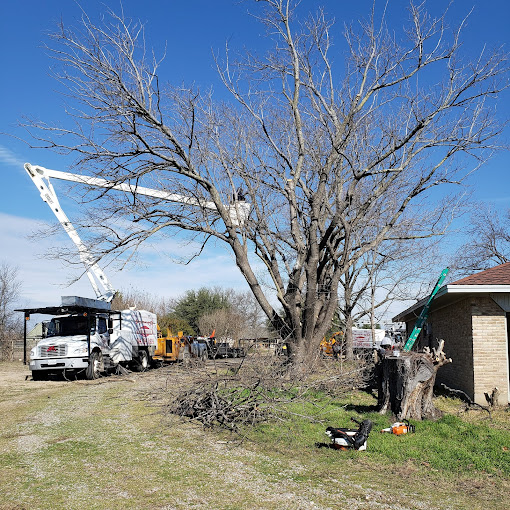
Emergency Tree Removal for Power-Line Clearance Safety
The night a thunderstorm tore through Plano, a commercial property manager called us because they could hear branches snapping near the parking lot lights. By morning, they noticed what had been “just wind” the night before—limbs had come dangerously close to service lines and utility equipment. Even if nothing sparked, that kind of proximity is a safety issue, not a landscaping problem.
When trees threaten power lines, homeowners and businesses often feel stuck between two risks: waiting could mean a live-line hazard, while cutting too aggressively can worsen the situation. As an arborist, I’ll tell you what we look for in the field and how we decide when emergency action is necessary to restore clearance safely and protect the tree when it can be preserved.
Quick Answer
If a tree is touching, leaning into, or even hanging within a critical distance of power lines, treat it as an emergency. Do not attempt DIY removal—fallen or sagging branches can shift, and many “looks okay” situations still involve live-line risk. A professional emergency tree service will assess stability, determine whether the tree can be worked from a safe distance, and coordinate safe removal or pruning to restore proper clearance.
What an Arborist Looks for During Power-Line Threats
Emergency tree removal isn’t just about cutting wood—it’s about managing movement, load, and failure risk. During a clearance event, we assess:
- Contact vs. clearance: A tree can be “not touching” yet still be unsafe due to sagging limbs, wind-driven sway, or loosened structural unions.
- How the limb is loaded: A snapped branch may be hanging under tension. Cutting the wrong section can release stored energy and swing the limb into the line.
- Whole-tree stability: Storm damage often creates hidden lean or root compromise. We evaluate whether the tree could shift when worked on.
- Branch attachment quality: Weak codominant stems, included bark, and compromised internal structure can fail even if the bark looks intact from a distance.
- Secondary hazards: In North Texas, storms frequently combine wind + heavy moisture + dry, brittle wood. That combination increases the odds of additional cracking during cleanup.
Firsthand observation from the field
One of the most common “surprises” we see is that the real damage isn’t the branch that broke—it’s the structural weakness that caused the break. I’ve inspected mature live oaks and ornamental pears where the visible snapped limb looked minor, but the union above it had a loosened attachment. The tree still stood, yet it was essentially “loaded” for the next gust. That’s why emergency clearance work needs a full stability read, not just a quick cut.
What Property Owners Often Overlook
Property owners tend to focus on what they can see: hanging limbs, broken branches, or an obvious lean. But power-line clearance threats often begin earlier than most people notice.
Common overlooked factors include:
- Interior crown growth that traps the line path. Mature trees can “reach” toward lines over time; dense interior limbs create a gradual hazard that only becomes obvious during windy seasons.
- Storm-wounded trees that look stable. After a storm, a tree can remain upright yet have damaged roots or a cracked stem. The next weather event can trigger failure.
- Pruning done incorrectly in the past. When cuts are made without proper structure planning, trees may regrow quickly with weaker architecture, increasing future clearance risk.
- Stump and root stress. A tree near a utility corridor may be stressed by grading, drought, and compacted soils—conditions that make wood-borer activity more likely and weaken long-term vigor.
If you’re managing a property with mature trees near overhead lines, periodic inspections are the difference between “routine trimming” and “emergency removal.”
Mistakes That Increase Tree Failure Risks
The most dangerous mistakes happen when people try to “solve” the problem without accounting for physics and utility safety.
Here are the common mistakes we see:
1. DIY cutting near power lines
Even if you think you can cut from the side, limbs can spring, twist, or shift unexpectedly—especially if they’re already under tension.
2. Removing only the visible branch
If the limb broke due to a weak union, removing the end won’t fix the underlying structural risk. The tree may still fail during the next wind event.
3. Over-pruning to “open space”
Severe topping or aggressive clearance cuts can increase regrowth and create new weak growth. In many cases, a structured crown thinning approach is safer for the tree and more predictable for future clearance needs.
4. Ignoring storm-damaged root or lean indicators
If a tree has moved, lifted, or has exposed roots, it may not behave normally. Emergency work may require full removal rather than “just trimming.”
5. Waiting because “nothing happened yet”
Clearance hazards can escalate quickly. A tree that’s stable in calm weather can become unstable when wind loads increase.
If your property is dealing with storm damage cleanup solutions, we recommend handling it quickly—with a plan that includes inspection, not just debris removal. For emergency-focused support, you may also want to review emergency tree removal support before scheduling any work.
Maintenance, Preservation, or Removal: What to Do Right Now
When power-line clearance is involved, the right goal depends on what the tree can safely tolerate. Sometimes we prune; sometimes we remove.
Pruning vs. Removal (how arborists decide)
Pruning is often appropriate when:
- The tree is otherwise healthy and stable.
- The hazard is primarily a specific limb/section encroaching toward lines.
- Proper clearance can be achieved without destabilizing the tree.
- Cuts can be performed safely from the ground or with appropriate rigging protocols.
Removal is often the safer choice when:
- The tree is leaning toward lines or shows root/structure compromise.
- The affected area includes broken unions or internal decay.
- The tree has multiple hazardous limbs that would require excessive removal.
- Wind events could easily trigger further failures.
A practical clearance checklist (for property managers and homeowners)
Use this to decide whether you need emergency action and to prepare for safe assessment:
- Keep the area clear: Prevent foot traffic and parking under the canopy.
- Look for motion: Is the tree swaying more than expected, or are limbs “hanging” at odd angles?
- Check for fresh breaks: New cracks, snapped twigs, or exposed wood are red flags.
- Assess the trunk and base: Any new lean, soil heaving, or exposed roots means stability may be compromised.
- Document from a safe distance: Photos help our team understand what you’re seeing.
- Call for emergency tree service: If lines are involved, treat it as time-sensitive.
If your situation is more about long-term clearance planning (before emergency events), proactive pruning is often the best prevention. You can explore tree removal service when the risk assessment indicates removal is the safest path, or professional pruning solutions when trimming can restore safer structure and clearance.
Example case (anonymized) — “near-miss” after a North Texas storm
A retail center in the Plano area reported limbs hanging close to an overhead service line after a summer storm. At first glance, the tree didn’t appear “down,” and the manager planned to wait for weekend cleanup. During inspection, we found a loosened structural union above the encroaching limb and soil disturbance at the base from the storm surge. The tree was still standing but had reduced stability.
Action taken: we performed emergency clearance work to eliminate line risk and removed compromised sections that would have failed during the next gust. In the same cleanup cycle, we also addressed debris that could become a future slip hazard in the parking area. The property avoided a higher-risk second event and restored safe access for customers.
Plano and North Texas Relevance: Why Power-Line Hazards Escalate Here
North Texas weather patterns—strong thunderstorms, rapid temperature shifts, and seasonal wind—create conditions where tree hazards can “wake up” quickly. In Plano specifically, many neighborhoods and commercial corridors include mature shade trees with branches that gradually extend into utility corridors over time.
Add clay soil, drought stress, and periodic grading near developments, and you get a recipe for:
- wood that becomes more brittle after stress
- weakened structural attachment
- increased susceptibility to internal decline
- faster progression from “minor damage” to “hazard”
We also see that insect pressure can worsen decline. When trees are stressed, they may become more vulnerable to wood-boring activity, which can weaken internal structure even if the canopy still looks “mostly fine.” If your tree is already compromised from a storm or has visible openings in bark, it may be part of a bigger health picture. In those cases, tree health management becomes part of the solution—not an afterthought.
For situations where root-zone improvement supports long-term resilience, deep soil work can be relevant. Depending on the tree and site, deep root fertilization services may be recommended as part of broader tree health care planning after the immediate hazard is resolved.
Quick Reference: Signs a Tree May Be Hazardous Near Lines
If you’re unsure whether the situation is “urgent,” these are the indicators we treat seriously:
- limbs are touching, scraping, or visibly sagging toward lines
- fresh cracks in the trunk or major limbs
- new lean after wind or heavy rain
- multiple broken branches in the same storm
- exposed roots, lifted soil, or a base that looks undermined
- dead or dying limbs in the same area repeatedly
- bark damage at unions (especially where two stems meet)
If you see any of the above, it’s safer to assume the risk is higher than it looks.
Seasonal Tree Care Checklist (to reduce future emergency events)
Emergency clearance is reactive. A good maintenance plan is preventative. Here’s a practical checklist for North Texas properties:
Spring (after peak freeze risk and as growth restarts)
- Inspect for storm micro-damage from winter winds.
- Check for crossing branches and interior crowding near utility corridors.
- Plan structural pruning if limbs are beginning to encroach.
- Look for early insect activity (bore holes, frass, or dieback).
Summer (when heat and drought stress peak)
- Monitor watering consistency for established trees.
- Watch for sudden canopy thinning and localized limb dieback.
- Avoid “cutting for quick clearance” without a structure plan—over-pruning can backfire.
- Inspect frequently if a tree has a history of storm issues.
Fall (best time for many corrective pruning decisions)
- Prioritize pruning that improves structure and reduces line risk.
- Remove deadwood and address weak attachments.
- Make sure the property is clear of hazards before colder storms.
Winter (focus on inspections and readiness)
- Conduct a risk survey after weather events.
- Identify trees that need attention before spring storms.
- Plan cleanup routes and access for emergency response.
If you’re operating a commercial property with strict uptime needs, schedule inspections early enough that you’re not reacting during the first big thunderstorm.
Key Takeaway
Power-line clearance hazards are about safety and structural stability, not just branch visibility. A professional emergency evaluation protects people, vehicles, and utilities—and it helps preserve trees when pruning can reduce risk without compromising long-term health.
FAQ
Can a tree be “safe enough” if it isn’t touching the power line?
Often, no. Many hazards involve proximity—branches can move in wind, sag when weighted by debris, or shift as storm damage loosens unions. If a tree is leaning, hanging, or repeatedly brushing near lines, treat it as urgent. A professional emergency tree service can assess stability and determine whether limited pruning can restore safe clearance or whether removal is the safest option.
What’s the difference between emergency tree removal and normal tree trimming?
Emergency tree removal focuses on immediate risk mitigation—stability, load management, and clearance to reduce danger quickly after storms or when lines are involved. Normal trimming is typically planned and structural, aiming to maintain safer growth patterns over time. If utility lines are involved, emergency protocols usually take priority.
What if my tree is damaged by the storm—can it be saved?
Sometimes. If the tree’s structure is intact and the damage is limited to manageable limbs, preservation through selective pruning may be possible. If there’s cracked unions, root disturbance, significant lean, or internal decline, removal may be the safer long-term choice. A proper inspection is the deciding factor.
Do stump grinding and removal matter after a tree is removed?
Yes—especially for safety, mowing access, and preventing future issues. Grinding also helps reduce trip hazards and allows you to restore the landscape more cleanly. If stump removal is part of your cleanup plan, you can ask about stump grinding assistance for a more complete site restoration.
Ready to Protect the Health and Safety of Your Trees?
If power-line clearance is involved, don’t wait for a “better weather day.” An emergency tree evaluation helps prevent escalation and guides the right next step—pruning where appropriate, removal when necessary, and follow-up care to protect long-term tree health.
About Parker Tree Service
Parker Tree Service provides emergency tree removal, storm damage tree service, pruning, stump grinding and removal, and arborist consulting throughout Plano, TX and surrounding North Texas communities. We focus on safety-first arboriculture, long-term tree health, and practical recommendations that help homeowners and commercial property managers reduce risk while preserving trees whenever it’s structurally sound.