
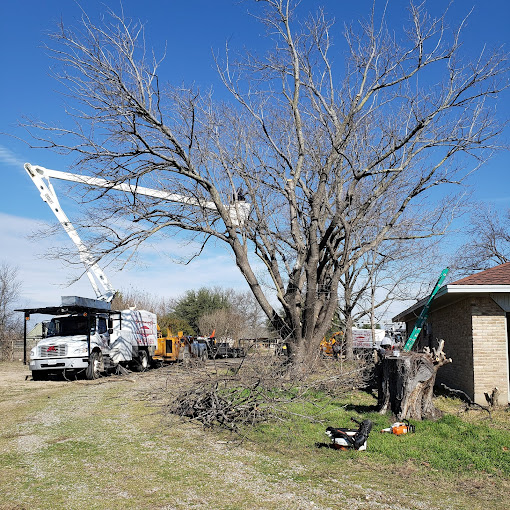
The wind has finally gone quiet, but your yard looks like a disaster zone. A massive oak limb is resting on the roofline, shingles are scattered across the lawn, and splintered branches block the driveway. You can hear sirens in the distance and see flashing lights on nearby streets as crews respond to downed power lines and traffic hazards. In that moment, you’re not thinking about landscaping or aesthetics; you’re thinking about safety, damage control, and how quickly you can get a qualified emergency tree removal crew to your Plano, TX property.
This is exactly when emergency tree removal solutions move from a “someday” concern to an immediate necessity. After a severe North Texas storm, trees that looked solid yesterday can become unstable, dangerous, and unpredictable. Limbs may be hanging by a strip of bark, trunks may be cracked internally, and root systems may be undermined by saturated soil and high winds. Trying to handle this with a chainsaw and a ladder is not just risky—it can be life-threatening. That’s why having a trusted team like Parker Tree Service ready to respond in Plano is so critical when storm damage strikes.
Emergency tree removal after a storm is not the same as routine trimming or scheduled removals. It involves working in unstable conditions, near damaged structures, and often under time pressure to prevent further harm. It requires specialized equipment, trained climbers, careful coordination with utilities, and a clear understanding of how to stabilize or dismantle a compromised tree without causing additional damage. Knowing what to expect, and what options exist, can help Plano homeowners and property managers make faster, smarter decisions when storms leave dangerous trees in their wake.
Understanding Storm Tree Hazards
Storm-damaged trees can be deceptive. From the ground, a tree may appear to be leaning only slightly or a broken limb may look stable, but internal fractures and hidden weaknesses can cause sudden failure. Strong winds can twist a tree’s trunk, causing spiral cracks that are difficult to see until the tree finally gives way. Hail and lightning can wound the upper canopy, leaving heavy limbs ready to drop unexpectedly days or even weeks after the storm has passed.
In Plano, TX, where fast-moving thunderstorms, straight-line winds, and occasional ice events are common, certain species are especially vulnerable. Shallow-rooted trees, older specimens with decay, or trees that were previously topped or poorly pruned are more likely to fail under stress. When Parker Tree Service arrives on a storm-damaged site, one of the first steps is a rapid but thorough assessment: Is the tree posing an immediate danger to people, structures, or utilities? Are there hanging limbs (often called “widow-makers”) that need to be removed first? Does the tree have enough structural integrity to be saved, or does it need to come down entirely?
Another layer of hazard comes from the environment around the tree. Downed power lines, gas lines, damaged fences, unstable roofs, and slippery ground all increase the risk of injury. Emergency tree removal specialists are trained to identify these secondary dangers before any cuts are made. They may coordinate with the power company to de-energize lines, work with roofers or restoration contractors, and establish safe zones to protect homeowners and bystanders. This careful planning is a key part of why professional intervention is so important after storm damage.
Why Professional Emergency Removal Matters
When a storm hits, it’s natural to want to clean up quickly. Homeowners often grab a saw, climb a ladder, and start cutting without realizing how unstable storm-damaged wood can be. Branches are under tension, trunks can shift suddenly, and one wrong cut can cause a massive log to roll, swing, or collapse onto a person, vehicle, or structure. Emergency tree removal is a specialized service precisely because the risk profile is so high.
Parker Tree Service brings a combination of training, experience, and equipment that simply isn’t accessible to the average property owner. Certified arborists and trained climbers understand how to “read” the stress points in a damaged tree, how to rig sections so they can be lowered safely, and how to use cranes or bucket trucks when necessary. They also know how to work around compromised roofs, fences, and windows to minimize additional damage as the tree is dismantled. In Plano’s dense neighborhoods, where houses, driveways, and utilities are close together, this level of precision is essential.
There’s also the issue of liability and insurance. When a professional, insured tree service handles emergency removal, you have a documented record of the work performed, the condition of the tree, and the steps taken to protect your property. This can be important when you’re working with your homeowner’s insurance company on storm damage claims. Reputable companies like Parker Tree Service understand the documentation insurers often request and can help provide photos, descriptions, and invoices that support your claim.
The Emergency Response Process
After a major storm in Plano, the phones at tree services start ringing immediately. Understanding how the emergency response process typically works can help you know what to expect when you call Parker Tree Service for urgent help. The first step is usually a rapid intake: confirming your location, the nature of the hazard, whether there are downed lines involved, and whether anyone is in immediate danger or trapped.
Once a crew is dispatched, they’ll begin with a safety-focused site assessment. They’ll look at the tree’s condition, the surrounding environment, and the safest access points for equipment. This assessment isn’t just a quick glance—it’s a structured evaluation that guides every decision that follows. For example, if a large tree has fallen across a roof but is also resting on a garage and a fence, the team must decide which sections to remove first to prevent shifting and collapse.
After the plan is established, the crew will set up rigging, staging areas, and, when needed, traffic or pedestrian control. In emergency situations, they may prioritize clearing driveways, access routes, or hazardous limbs before fully dismantling the tree. This staged approach allows essential functions—like getting your car out or allowing repair crews in—to resume as quickly as possible. Once the immediate danger is neutralized, the team can focus on complete removal, cleanup, and debris hauling, leaving your property in a safer, more manageable state.
Specialized Techniques For Storm Damage
Not all tree removals are alike, and storm damage often demands specialized techniques. One common method is sectional dismantling, where the tree is taken down piece by piece from the top or from strategic points, rather than felling it in one direction. Climbers or bucket truck operators use ropes, pulleys, and friction devices to lower each cut section carefully, avoiding impact on roofs, windows, and landscaping. This is especially critical in Plano neighborhoods where yards can be compact and obstacles numerous.
Crane-assisted removal is another powerful tool in the emergency toolkit. When a tree is too dangerous to climb or is precariously positioned over a structure, a crane can be used to lift large sections away. This requires tight coordination between the crane operator and the tree crew, with each cut and lift carefully planned. The advantage is that heavy sections can be moved without dragging or dropping them across the property, significantly reducing the risk of secondary damage.
Storm-damaged trees also call for advanced rigging solutions. Because wood fibers can be splintered and unpredictable, crews use redundancy in their rope systems, backup anchor points, and controlled lowering techniques. They may also employ mechanical advantage systems to manage weight and tension, ensuring that no individual worker is exposed to unsafe loads. These are not improvisations; they are tested methods that trained professionals at Parker Tree Service apply specifically for hazardous storm scenarios.
Working With Insurance And Documentation
After the immediate danger has been addressed, the next challenge many Plano homeowners face is navigating insurance claims. Storm damage can involve multiple components: roof repair, fence replacement, vehicle damage, interior water intrusion, and tree removal. Insurers often distinguish between preventative work and necessary emergency services, so having clear documentation of the tree’s condition and the urgency of the removal can influence what is covered.
Parker Tree Service can help by providing detailed invoices and, when requested, descriptions of the emergency conditions encountered: for example, a large limb penetrating a roof, a tree that has crushed part of a structure, or a trunk that was leaning dangerously toward a living area. Crews frequently take before-and-after photos that can be shared with your adjuster, illustrating the extent of the damage and the complexity of the removal.
It’s wise to contact your insurance company as soon as it’s safe to do so after a storm. Ask what documentation they need and whether they require specific wording regarding “emergency tree removal” or “mitigation of further damage.” While Parker Tree Service does not act as a public adjuster, their experience working on storm-damage sites in Plano means they understand the typical expectations and can tailor their job descriptions and receipts to support your claim process more effectively.
Prevention And Preparedness For Future Storms
While no one can control the weather, you can significantly reduce the likelihood of catastrophic tree failures by investing in proactive care. Many of the emergencies seen after storms in Plano involve trees that had pre-existing issues: dead limbs, decay at the base, poor structure, or past improper pruning. A periodic inspection by an arborist from Parker Tree Service can identify these red flags before the next severe storm arrives.
Preventive actions might include crown thinning to reduce wind resistance, cabling or bracing weak unions, removing dead or diseased limbs, or, in some cases, preemptively removing a tree that has become too hazardous to retain. Addressing soil health and root conditions can also improve stability; services such as Tree Surveys and other root-focused care help trees better withstand weather extremes by promoting stronger, healthier root systems.
Preparedness also means having a plan. Keep important phone numbers, including Parker Tree Service, easily accessible. Know where your utility shutoffs are, and keep photos of your property and trees in their pre-storm condition for reference. Simple steps like securing outdoor furniture and yard items can prevent additional impact damage to trees and structures during high winds. While you cannot eliminate all risk, a combination of preventive tree care and practical planning can make storm seasons far less stressful.
Frequently Asked Questions
How do I know if a storm-damaged tree is an emergency? A tree is considered an emergency when it poses an immediate risk to people, structures, or utilities. Signs include limbs resting on or penetrating a roof, trees leaning suddenly toward a house or power line, large broken branches hanging precariously, or any tree movement accompanied by cracking sounds. If you are unsure, it is safer to treat the situation as urgent and call a professional like Parker Tree Service in Plano to assess the risk on-site.
Can I handle storm cleanup myself if the damage looks minor? Light debris such as small branches can often be safely handled by homeowners, but anything involving ladders, chainsaws, or large limbs should be approached with extreme caution. Storm-damaged wood can be under unpredictable tension, and cuts that seem straightforward can cause sudden shifts. If there is any question about stability, proximity to structures, or overhead hazards, it is far safer and often more cost-effective to have a professional crew perform the work.
Will my homeowner’s insurance cover emergency tree removal? Coverage varies by policy, but many homeowner’s insurance plans in Plano, TX, will cover at least part of the cost of tree removal when a tree damages a covered structure, such as a house, garage, or fence. If the tree simply falls in the yard without damaging anything, coverage may be limited. It is important to contact your insurer promptly after the storm, provide photos, and share documentation from Parker Tree Service detailing the emergency nature of the removal.
How quickly can Parker Tree Service respond after a storm? Response time depends on the severity of the storm and the volume of calls, but emergency situations are prioritized. Trees that have fallen on homes, blocked essential access, or created dangerous conditions near power lines are typically addressed first. When you call, providing clear information about the hazard and sharing any photos you can safely take will help the team triage and schedule their response as efficiently as possible.
Is it always necessary to remove a storm-damaged tree, or can it sometimes be saved? Not every storm-damaged tree needs to be removed. In some cases, skilled pruning, cabling, or selective removal of damaged limbs can preserve the tree while restoring safety. The decision depends on factors such as the extent of structural damage, the tree’s species and age, and its location relative to targets like homes or driveways. An experienced arborist from Parker Tree Service can evaluate whether repair is feasible or whether removal is the safest long-term solution for your Plano property.