
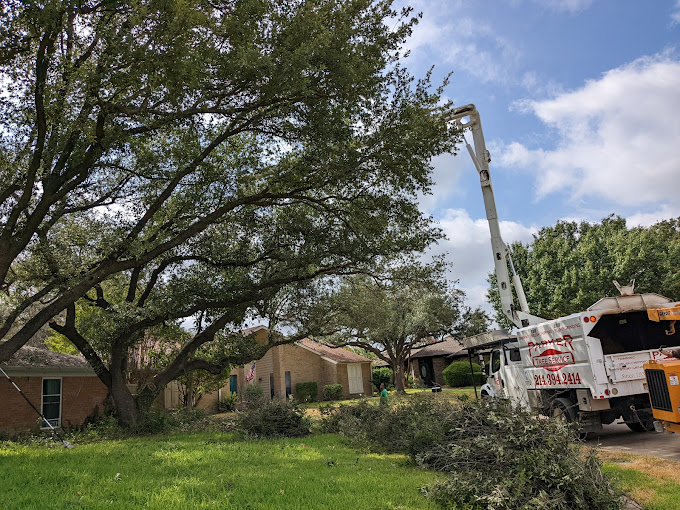
Late one February afternoon in Plano, a homeowner steps into the backyard and realizes the live oak that once framed the patio now looks crowded, heavy, and a little tired. Branches are sagging over the roof, interior limbs are bare, and the tree seems to be reaching for light in all the wrong directions. The homeowner has a pair of hand pruners in the garage and a ladder, but also a nagging feeling that one bad cut could do more harm than good. This moment – standing under a tree that clearly needs attention but not knowing where to begin – is where professional pruning techniques make all the difference.
Tree pruning is not just about cutting off branches that are in the way. Done correctly, it is a deliberate, science-based process that shapes how a tree grows for years to come. Each cut influences the tree’s energy, structure, and long-term stability. In a climate like Plano, TX, where heat, storms, and occasional ice events stress trees, proper pruning techniques can be the difference between a thriving, balanced canopy and a hazardous liability. Professional arborists at Parker Tree Service approach pruning as both a health treatment and a structural investment in your landscape.
When pruning is handled by trained professionals, trees respond with stronger growth, better airflow, improved resistance to disease, and a more attractive form. Poor or careless pruning, on the other hand, can leave trees vulnerable to decay, breakage, and premature decline. Understanding what professional pruning actually involves – and why it matters – helps homeowners make smarter decisions about their trees and know when it is time to call in experts.
Why Pruning Matters
Every tree in your yard is constantly making choices about where to send its energy: to new shoots, to roots, to repair, or to defense against pests and disease. Pruning guides those choices. By selectively removing certain branches, a professional arborist redirects a tree’s growth into its strongest, healthiest parts. For example, eliminating weak, crossing, or rubbing limbs reduces competition and allows the tree to develop a more stable framework. This is especially important for fast-growing species common in Plano, like ash and some ornamental pears, which can become structurally unsound if left unpruned.
Pruning also plays a critical role in safety. Overextended limbs over roofs, driveways, and play areas can fail during storms, especially when they are poorly attached or decayed. In North Texas, spring winds and summer storms can place enormous strain on heavy, unbalanced canopies. Professional pruning techniques reduce this risk by thinning and shortening strategic branches to lessen weight and wind resistance while maintaining the tree’s natural shape. This kind of structural pruning is subtle; it is less about dramatic before-and-after photos and more about preventing limb failure years down the road.
Another key benefit of pruning is improved plant health. Dense, crowded canopies trap humidity and shade interior branches, creating ideal conditions for fungal diseases and insect problems. Professional arborists open the canopy just enough to allow sunlight and airflow to reach interior foliage. This helps leaves dry more quickly after rain or irrigation, reduces fungal pressure, and encourages a more even distribution of foliage throughout the tree. Over time, a well-pruned tree will often show fuller, more vibrant growth than one that is left completely alone.
Understanding Different Pruning Cuts
Not all pruning cuts are created equal, and professionals use specific types of cuts for specific goals. One of the most important distinctions is between a heading cut and a thinning cut. A heading cut shortens a branch by cutting it back to a bud or a small lateral branch, often used to reduce length or control direction. A thinning cut removes an entire branch back to its point of origin, such as where it meets a larger limb or the trunk. Thinning cuts are typically preferred in structural pruning because they preserve the natural form and reduce regrowth that can become dense and weak.
Professionals also pay close attention to the branch collar – the slightly swollen area where a branch meets the trunk or parent limb. This is where the tree is naturally equipped to seal off a wound. Cutting just outside the branch collar, without damaging it, allows the tree to compartmentalize the wound and reduce the risk of decay spreading into the main trunk. Flush cuts, which remove the branch collar, and stub cuts, which leave a long dead piece, both interfere with the tree’s ability to close the wound properly. At Parker Tree Service, crews are trained to recognize these subtle anatomical features so every cut supports the tree’s natural healing process.
For larger limbs, professionals use a three-cut method to prevent bark tearing. The first cut is an undercut a short distance from the trunk, the second is a top cut slightly farther out to remove the weight of the branch, and the final cut is made just outside the branch collar to finish the pruning. This technique prevents the branch from ripping down the trunk as it falls, which can create large, ragged wounds that invite decay. It seems like a small detail, but over decades, the difference between careful cuts and careless ones can determine whether a tree remains sound or becomes hollow and unsafe.
Timing Pruning For Plano’s Climate
In Plano, TX, timing is a crucial part of professional pruning strategy. The region experiences hot summers, occasional drought, and periodic cold snaps, all of which influence how trees respond to pruning. For most shade trees, late winter through very early spring – before new growth starts – is an ideal time. Trees are still dormant, energy reserves are stored in the roots and trunk, and cuts made during this period generally heal efficiently once growth resumes. This timing also makes it easier to see the tree’s structure without leaves in the way.
However, not all trees follow the same schedule. Flowering ornamentals, such as crape myrtles, redbuds, and some fruit trees, may require more precise timing if you want to preserve blooms. Many spring-flowering trees set their flower buds the previous summer or fall. Pruning them too late in winter or early spring can remove those buds and reduce the flowering display. Professional arborists factor in both the species and the homeowner’s aesthetic goals when choosing when to prune, balancing flower production with structural needs.
Another timing concern in North Texas is stress from heat and drought. Heavy pruning during peak summer heat can put additional strain on a tree that is already working hard to conserve water. In most cases, professionals avoid major pruning during the hottest months unless there is a safety or emergency issue, focusing instead on removing dead or hazardous limbs only. For oaks, timing is even more specific due to the risk of oak wilt; pruning is best done in the coldest months, and cuts are often treated to reduce the chance of infection. Knowledge of local conditions and tree diseases is one reason homeowners in Plano often rely on Parker Tree Service for timing-sensitive work.
Structural Pruning For Young And Mature Trees
Professional pruning techniques look different depending on the age of the tree. With young trees, the focus is on establishing a strong, stable structure that will support the canopy as it grows. Arborists aim to develop a single dominant leader (main trunk) and well-spaced lateral branches that form a balanced framework. This might involve selectively shortening or removing competing leaders, eliminating steep V-shaped crotches that are prone to splitting, and choosing permanent scaffold branches at appropriate spacing and angles. A few strategic cuts in a tree’s early years can prevent major structural problems decades later.
For mature trees, structural pruning is more about refinement and risk reduction than shaping. Large established trees in Plano neighborhoods often have multiple heavy limbs extending over homes, streets, and power lines. In these cases, arborists look for signs of weakness such as cracks, decay pockets, narrow branch unions, and excessive end weight. By performing reduction cuts to shorten overextended branches and thinning cuts to reduce load, they can significantly lower the risk of limb failure without disfiguring the tree. The goal is always to respect the tree’s natural architecture while making it safer and more resilient.
In both young and mature trees, professionals also consider clearance and function. Branches rubbing against roofs, blocking sightlines at driveways, or interfering with sidewalks and structures may need to be pruned for practical reasons. Rather than simply cutting branches back to arbitrary points, Parker Tree Service arborists choose cut locations that maintain branch strength and natural form. This thoughtful approach results in trees that coexist with structures and people without looking hacked or unbalanced.
Avoiding Common Pruning Mistakes
Some of the most serious problems arborists see in Plano yards are caused not by neglect, but by well-intentioned but improper pruning. Topping – the drastic cutting back of large branches to random stubs – is one of the worst offenders. Topped trees respond by sending out a flush of weak, fast-growing shoots that are poorly attached and highly susceptible to breakage. The large, flat wounds left by topping also invite decay and can dramatically shorten a tree’s lifespan. Professional pruning always avoids topping and instead uses targeted reduction and thinning to manage size and shape.
Another common mistake is over-thinning the interior of the canopy, sometimes called “lion-tailing.” This happens when too many inner branches are removed, leaving foliage only at the ends of long, bare limbs. While it may look open and airy at first, lion-tailing shifts weight to the ends of branches, increases wind stress, and can lead to branch failure. It also exposes previously shaded bark and limbs to sudden sun, potentially causing sunscald. Proper thinning removes selected branches throughout the canopy, maintaining foliage along the length of limbs and preserving a balanced structure.
Homeowners also frequently underestimate the importance of clean, sharp tools and correct cut placement. Ragged cuts made with dull saws take longer to close and can harbor disease. Cuts made too close to the trunk or too far out as stubs both interfere with the tree’s natural healing processes. Professional crews from Parker Tree Service use well-maintained equipment and follow established pruning standards, such as those from the International Society of Arboriculture, to ensure every cut supports the tree’s health rather than undermining it.
When To Call A Professional
There are certainly small pruning tasks a homeowner can handle safely, such as removing minor dead twigs within arm’s reach or clipping suckers from the base of a tree. However, once pruning involves ladders, chainsaws, or branches larger than your wrist, it becomes a job best left to professionals. Working at height around live branches, power lines, and structures can be dangerous without proper training and safety gear. Professional arborists have the equipment, climbing skills, and risk assessment experience to perform complex pruning without putting people or property in harm’s way.
In addition to safety, professionals bring diagnostic expertise. A branch might look healthy from the ground but actually be hollow or severely decayed at the union. A subtle crack or fungal conk can completely change how an arborist approaches pruning that limb. Parker Tree Service teams in Plano evaluate the whole tree – its species, age, site conditions, and existing defects – before deciding which branches to remove and which to keep. This holistic perspective ensures pruning decisions support both immediate safety and long-term tree health.
Finally, professional pruning is an investment in the value and appearance of your property. Well-maintained trees frame a home, provide shade that reduces cooling costs in the Texas heat, and create inviting outdoor spaces. Poorly pruned or damaged trees, on the other hand, can detract from curb appeal and pose ongoing hazards. Partnering with a reputable local company for periodic pruning, along with related services like Affordable Stump Removal when necessary, helps keep your landscape both beautiful and safe over the long term.
Frequently Asked Questions
How often should my trees be professionally pruned in Plano, TX? Most established shade trees benefit from a professional pruning cycle of every 3 to 5 years, though this can vary by species, age, and location. Fast-growing trees or those in high-risk areas (near structures, over driveways, or along streets) may need more frequent attention. Younger trees may need structural pruning every 2 to 3 years to guide their development, while slower-growing, mature trees might go longer between visits if they are in good condition. An on-site evaluation by Parker Tree Service can help determine the right schedule for each tree on your property.
Is it okay to prune my trees in the summer? Light pruning in summer, such as removing small dead branches or minor clearance cuts, is generally acceptable. However, major pruning that removes a significant portion of the canopy is best done during the dormant season to reduce stress on the tree. In Plano’s hot climate, heavy summer pruning can expose interior bark to intense sun and heat, potentially causing damage. There are exceptions for safety issues or storm-damaged limbs, where immediate pruning is necessary regardless of season, but routine structural work is usually scheduled for late winter or early spring.
Will pruning make my trees grow faster? Pruning does not exactly make trees grow faster, but it can help them grow better. By removing weak, diseased, or crossing branches, pruning directs the tree’s energy into stronger limbs and healthy foliage. This often results in more vigorous, balanced growth where it matters most. Over-pruning, however, can have the opposite effect, stressing the tree and forcing it to devote resources to emergency regrowth rather than steady development. Professional pruning focuses on removing only what is necessary to improve structure, safety, and health without shocking the tree.
Can I prune large branches myself if I have a chainsaw? Having a chainsaw does not necessarily mean it is safe to tackle large branches on your own. Cutting heavy limbs, especially overhead or near structures, involves significant risk. Branches can swing unpredictably as they fall, ladders can shift, and hidden defects in the wood can cause unexpected failures. Professionals use ropes, rigging, and specialized techniques to control the direction and speed of falling branches, protecting both the worker and the property. For any branch that requires a ladder or is larger than your wrist, it is much safer to call a professional service.
What signs indicate my tree needs professional pruning? There are several warning signs that suggest it is time to bring in an arborist. These include branches rubbing on roofs or siding, limbs hanging low over driveways or sidewalks, dead or broken branches high in the canopy, excessive crossing or crowded limbs, and visible cracks or decay at branch unions. You might also notice that your tree is heavily shaded inside with most foliage only on the outer edges, or that it leans more than it used to. In Plano, after strong storms, it is wise to have trees inspected for subtle damage that may not be obvious from the ground. A professional evaluation from Parker Tree Service can identify pruning needs before they turn into bigger problems.