
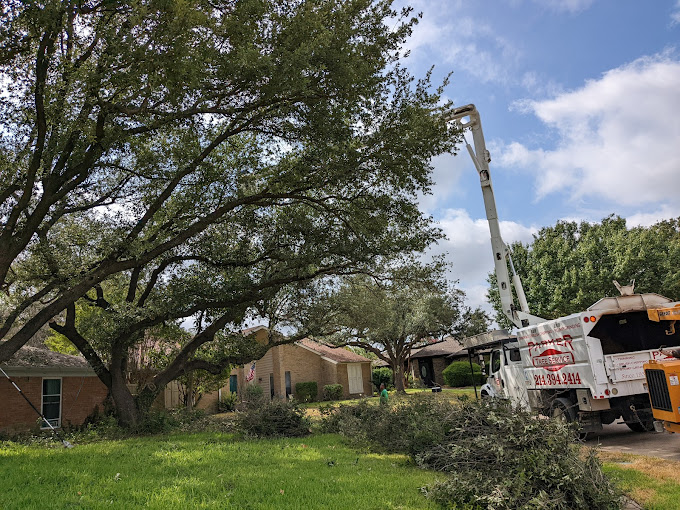
Tree Pruning That Enhances Shape, Strength, and Shade
On a hot Plano afternoon, the difference between a well-pruned shade tree and a neglected one is obvious. One yard feels 10–15 degrees cooler with a broad, healthy canopy; the neighbor’s yard bakes under sparse, stressed branches. In North Texas, where summer heat and sudden storms are part of life, how your trees are pruned directly affects comfort, curb appeal, and safety.
Research shows that proper structural pruning in a tree’s early years can reduce future storm damage by up to 50%. Poor pruning, on the other hand, increases the risk of branch failure, decay, and costly Tree Removal later on. For Plano property owners and managers, that’s not just a landscape concern—it’s a liability issue and a long-term investment decision.
This guide explains how thoughtful, expert tree pruning can enhance your trees’ shape, strength, and shade—and how to get it done safely and correctly in our unique North Texas environment. You’ll learn which techniques matter, how often to prune, what to avoid, and when to call in a professional arborist for help.
Key Insight: Smart pruning is less about cutting more and more about cutting with purpose—guiding growth, preventing failure, and maximizing shade and beauty for decades.
Why Strategic Pruning Matters More in North Texas
Plano’s trees live in a tough neighborhood: clay-heavy soils, intense sun, heat waves, and sudden windstorms. That combination makes strategic pruning a necessity, not a luxury.
Climate and Soil Pressures
Our black clay soils expand and contract with moisture changes, stressing root systems. Add prolonged droughts and then fast, heavy storms, and you have trees that:
- Develop weak, fast-grown branches
- Form heavy, unbalanced canopies
- Suffer from root stress and nutrient deficiencies
Without proper Tree Pruning, these conditions lead to broken limbs, sunscald, and in severe cases, complete tree failure.
“Most storm-damaged trees we see in Plano had structural issues that could have been corrected years earlier with proper pruning.” — ISA Certified Arborist, Parker Tree Service
Local Example: The Split Red Oak
A Plano homeowner called after a summer thunderstorm split their 20-year-old red oak almost in half. The tree had multiple co-dominant trunks and dense interior branches. No structural pruning had ever been done.
- One side of the tree failed during high winds
- The broken trunk narrowly missed the roof
- The homeowner needed Emergency Tree Removal and Stump Grinding, turning a preventable maintenance issue into a major expense
With periodic structural pruning over the years, that red oak could have remained a strong, symmetrical shade tree instead of a hazard.
Shaping Trees for Beauty Without Sacrificing Health
A well-shaped tree frames your home or building, complements your architecture, and adds instant curb appeal. But shaping should never come at the cost of tree health or stability.
Good Shaping vs. Harmful Topping
Tree shaping the right way focuses on:
- Encouraging a strong central leader (when appropriate for the species)
- Balancing branches around the trunk
- Removing crossing, rubbing, or competing limbs
- Preserving the natural form of the tree
By contrast, topping—cutting large limbs back to stubs—is one of the most damaging things you can do. It:
- Creates weakly attached, fast-growing sprouts
- Opens large wounds that invite decay and pests
- Destroys the tree’s natural form and shade pattern
CALLOUT: A properly shaped tree looks natural, not “sculpted.” If your tree looks like a lollipop or a hat rack, it’s probably been over-pruned.
Plano Case Study: Commercial Office Park
A Plano office park wanted cleaner lines and better visibility of their signage but didn’t want to lose shade in the parking lot. They initially requested aggressive cutting, worried that subtle pruning wouldn’t make enough difference.
Parker Tree Service recommended:
- Selective Professional Tree Trimming instead of topping
- Raising the canopy slightly along walkways
- Thinning interior branches to allow filtered light without removing major limbs
The result:
- Signage became visible from the street
- The parking lot remained shaded
- The property’s trees looked natural and healthy rather than over-cut
Shaping isn’t about making trees smaller; it’s about guiding growth so the tree fits its space—driveways, roofs, sidewalks, and power lines—without constant emergency cutting.
Building Stronger Trees: Structural Pruning for Long-Term Stability
Strength is built into a tree over time. Structural pruning is the process of training a tree’s framework so it can withstand wind, ice, and heavy foliage.
What Structural Pruning Targets
On young and maturing trees, structural pruning focuses on:
- Developing a dominant leader (for species that should have one)
- Spacing main scaffold branches vertically and around the trunk
- Keeping branch angles wide and strong
- Reducing or removing co-dominant stems that can split later
This kind of pruning is especially important for species common in Plano—like live oaks, red oaks, elms, and Bradford pears—which can develop weak branch unions if left untrained.
“Correcting poor structure early on is like orthodontics for trees—far cheaper and more effective than trying to fix a disaster later.” — Parker Tree Service Arborist
Local Example: Preventing Future Storm Damage
A Plano HOA contacted Parker Tree Service after seeing neighboring properties suffer heavy storm damage. Their community had dozens of 10–15-year-old live oaks planted along streets and common areas.
Our arborists:
- Performed a Tree Risk Assessment
- Identified co-dominant trunks and tightly angled branches
- Used reduction cuts to subordinate competing leaders
- Removed weak, rubbing, and crossing limbs
Five years and multiple storms later, those trees have remained intact while similar unpruned plantings nearby have experienced significant breakage.
Maximizing Shade Without Over-Thinning the Canopy
Shade is one of the biggest benefits trees provide in Plano’s climate. Proper pruning can actually increase usable shade, while poor pruning can reduce it dramatically.
Understanding Light, Airflow, and Leaf Density
The goal of canopy pruning is to:
- Allow enough light and air movement to reduce disease risk
- Maintain a dense enough canopy for effective shade
- Avoid heavy interior thinning that causes sunscald and stress
Over-thinning (sometimes sold as “lion-tailing”) removes too many interior branches and leaves most foliage concentrated at the ends of limbs. This:
- Increases wind sail effect and branch failure risk
- Exposes bark to sudden sunlight, causing sunscald
- Reduces the cooling effect of layered shade
Selective Tree Crown Thinning is different. It removes carefully chosen branches throughout the canopy to improve airflow while preserving overall density.
Plano Backyard Example: Hot Patio Turned Comfort Zone
A homeowner in west Plano had a large pecan tree shading their patio, but the lower limbs blocked views and made the space feel dark. They were tempted to remove the tree entirely and called about Tree Removal Near Me.
Instead, Parker Tree Service recommended:
- Raising the canopy slightly over the patio
- Selectively thinning small interior branches
- Preserving key shade-producing limbs
After pruning, the patio felt brighter yet remained significantly cooler than the surrounding yard. The family kept their mature shade tree and avoided unnecessary removal.
Modern vs. Old-School Pruning: Techniques, Tools, and Safety
Tree care has evolved significantly over the past couple of decades. Modern arboriculture emphasizes tree biology, structural integrity, and long-term health instead of quick cosmetic fixes.
Comparison: Traditional vs. Modern Pruning Approaches
Below is a simplified comparison of older “hack and stack” methods versus today’s best practices:
| Aspect | Old-School Approach | Modern, ISA-Guided Approach |
|---|---|---|
| Main goal | Make tree smaller quickly | Improve structure, health, and safety |
| Cuts used | Heading cuts, topping, large stubs | Proper reduction and removal cuts at branch collar |
| Canopy thinning | Heavy interior stripping (lion-tailing) | Selective thinning, preserve interior foliage |
| Tools & techniques | Spikes on live trees, dull saws | Rope & saddle climbing, sharp saws, clean cuts |
| Safety focus | Minimal, often no PPE | Full PPE, ANSI standards, jobsite safety plans |
| Long-term impact | Weak re-growth, decay, repeated problems | Stronger structure, fewer future interventions |
Why This Matters in Plano
With dense neighborhoods, tight lot lines, and high property values, Plano tree work often happens close to homes, vehicles, and power lines. That makes modern, safety-focused Tree Service Near Me essential.
A local business park once hired the lowest bidder for major pruning. The crew:
- Used climbing spikes on healthy shade trees
- Left large stubs and torn bark
- Over-thinned the canopies
Within three years, several trees declined severely, one failed in a storm, and the property manager ultimately needed Dead Tree Removal and replacement planting—spending far more than a quality pruning job would have cost initially.
Integrating Pruning with Overall Tree Health Care
Pruning is powerful, but it’s only one part of keeping trees healthy and safe. In Plano’s challenging soils and climate, pruning decisions should be tied to a broader tree health strategy.
Coordinating Pruning with Soil and Root Care
Trees stressed by poor soil and root conditions respond poorly to aggressive pruning. A comprehensive approach may include:
- Deep Root Fertilization to improve nutrient uptake
- Soil Conditioning to address compaction in clay soils
- Mulching to moderate soil temperature and moisture
- Tree Root Care to address girdling or damaged roots
For example, a Plano homeowner with a struggling live oak requested heavy crown reduction to “save” the tree. Our arborist discovered severe root compaction from nearby construction and recommended:
- Light, corrective pruning only
- Vertical mulching and soil conditioning
- A deep root feeding program
Within two growing seasons, the tree’s canopy filled in, and new growth looked vigorous—without the stress of unnecessary heavy pruning.
Pruning and Pest/Disease Management
Open wounds from improper cuts can invite pests and pathogens. In North Texas, that often means:
- Wood borers and other insects requiring targeted Tree Pest Control
- Webworms that benefit from both pruning and Webworms Treatment
- Fungal issues exacerbated by poor air circulation
Coordinating pruning with Tree Disease Treatment and Tree Insect Treatment helps protect trees from decline.
“Pruning should never be done in isolation. We always consider soil, water, pests, and the tree’s overall vigor before deciding how much to remove.” — Parker Tree Service Arborist
Cost, Timing, and Planning: Getting the Most from Your Pruning Budget
Pruning is an investment, and like any investment, timing and planning affect your return—especially for businesses and HOAs managing multiple trees across a property.
Seasonal Timing in Plano
While many trees can be pruned year-round with care, certain windows are ideal:
- Late winter: Excellent for structural pruning on many species
- Late fall to early spring: Good visibility of structure on deciduous trees
- After major storm seasons: Inspections and corrective pruning
Summer pruning in Plano requires extra caution to avoid stressing heat-sensitive species. A knowledgeable arborist will adjust techniques and intensity based on species and current conditions.
Cost-Benefit Snapshot for Local Properties
Below is a general comparison of proactive pruning vs. reactive storm cleanup, based on typical Plano scenarios:
| Scenario | Proactive Pruning Program | Reactive Storm Cleanup Only |
|---|---|---|
| Frequency | Every 2–5 years | Only after visible damage |
| Typical cost over 10 years (per tree) | Moderate, predictable | Highly variable, often higher overall |
| Risk of property damage | Significantly reduced | Higher, especially near structures |
| Tree lifespan | Longer, with better structure | Shorter, more likely to need removal |
| Additional costs | Minimal | Emergency call-outs, Emergency Tree Service, Stump Removal |
Real-World Example: Plano HOA Budget Strategy
A Plano HOA with more than 100 trees used to handle issues only when branches broke or residents complained. After a particularly bad storm season, they:
- Commissioned a full Tree Survey and Tree Inspection
- Prioritized high-risk trees for immediate work
- Scheduled the rest on a 3-year rotating pruning plan
Over the next five years, they saw:
- Fewer emergency calls
- Lower overall tree-related expenses
- Healthier, more attractive common areas
What This Means for Businesses in Plano, TX
For Plano businesses, HOAs, and commercial property managers, tree pruning has a direct impact on both the bottom line and brand image.
Healthy, well-shaped trees:
- Enhance curb appeal and tenant satisfaction
- Provide cooler outdoor spaces for customers and employees
- Reduce energy costs by shading buildings and parking lots
- Lower the risk of injury and property damage from falling limbs
In a competitive market like Plano, where Class A offices, retail centers, and multifamily communities all vie for attention, landscape quality is often a deciding factor. Overgrown, poorly pruned, or hazardous trees send the wrong message about how a property is maintained.
On the risk management side, proactive pruning:
- Decreases the likelihood of emergency calls during storms
- Helps avoid costly Hazardous Tree Removal
- Supports long-term tree preservation instead of frequent replacement
Plano’s rapid development also means more trees are growing in tight urban and suburban spaces—near parking lots, sidewalks, signage, and structures. That makes professional planning, including Tree Mitigation and Tree Preservation Services, critical for long-term viability.
Working with a local, experienced provider like Parker Tree Service gives businesses access to ISA-trained arborists who understand Plano’s specific tree species, soil challenges, and municipal regulations. The result: safer properties, stronger trees, and a more attractive, comfortable environment for everyone who uses your space.
Frequently Asked Questions
Q: How often should commercial properties in Plano schedule tree pruning?
A: Frequency depends on species, age, and site conditions, but most commercial properties in Plano benefit from a 2–5 year pruning cycle. Young trees may need structural pruning every 2–3 years to establish strong frameworks, while mature trees often do well with inspections every 3–5 years and pruning as needed. Properties with high traffic, parking lots, or large canopy trees near buildings should consider more frequent Tree Maintenance Services to manage risk. A site-specific plan, developed through a professional Tree Consultation, will balance safety, aesthetics, and budget.
Q: Can pruning fix a tree that’s already leaning or has major structural problems?
A: Pruning can often reduce risk and improve balance, but it can’t always “fix” severe structural defects. For trees with significant lean, decay, or large co-dominant stems, an arborist may recommend a combination of targeted pruning, Tree Cabling and Bracing, and ongoing monitoring. In some cases, especially where there’s a high risk to buildings or people, Hazardous Tree Removal may be the safest option. A thorough Tree Risk Assessment by an ISA arborist is essential before making that decision.
Q: Is it safe to prune my own trees, or should I always hire a professional?
A: Light pruning from the ground—such as removing small, low branches on young trees—is often safe for homeowners. But once work involves ladders, chainsaws, or branches over structures, it’s time to call in a professional Tree Service. In Plano’s neighborhoods, many trees are close to homes, fences, and power lines, increasing the risk of property damage and injury. Professional crews follow ANSI safety standards, use proper rigging techniques, and carry insurance. For commercial properties, using a reputable provider is particularly important for liability and compliance reasons.
Q: What’s the difference between trimming, pruning, and reduction?
A: In everyday language, these terms are often used interchangeably, but they have specific meanings in arboriculture. “Pruning” generally refers to selective removal of branches to improve structure, health, or safety. “Trimming” is sometimes used for more cosmetic work, such as shaping hedges or small ornamentals. “Reduction” refers to carefully shortening branches or the overall crown size using proper reduction cuts—often to clear structures or reduce load. A professional Tree Pruning Service will explain which techniques they recommend and why, based on your tree’s species and goals.
Q: How does pruning relate to pest and disease control for Plano trees?
A: Proper pruning can significantly reduce pest and disease pressure by improving airflow, removing infected limbs, and eliminating deadwood that attracts insects. However, poor cuts or over-pruning can have the opposite effect, creating large wounds and stress that invite problems like borers and fungal decay. In Plano, integrated management may include pruning alongside Tree Borer Control, Wood Borer Treatment, or targeted Tree Disease Treatment. Timing is important too; certain species should not be pruned during periods when specific pests are most active.
Q: Are there local regulations in Plano regarding tree pruning or removal?
A: Yes, depending on your property type and location, there may be regulations governing significant pruning, Tree Removal, and Tree Mitigation. Commercial developments, multi-family communities, and certain residential areas with protected trees often require permits or adherence to specific guidelines. Plano’s development codes may also address tree preservation during construction, Lot Clearing, or Land Clearing. Working with an arborist familiar with local ordinances helps ensure compliance and can streamline approvals.
Q: How do I know if a tree needs pruning or complete removal?
A: Not every problematic tree has to come down. Signs that pruning may be sufficient include minor deadwood, moderate canopy imbalance, or clearance issues over roofs and sidewalks. However, advanced decay, major root damage, severe lean toward a target, or repeated large branch failures may indicate that Tree Removal Service is the safer long-term solution. An ISA-certified arborist can evaluate your tree’s structural integrity, root health, and site conditions and recommend whether pruning, bracing, or Fallen Tree Removal and replacement is the best path.
Ready to Get Started?
North Texas weather isn’t getting any milder, and trees don’t correct structural problems on their own. Each storm season that passes without a professional pruning plan increases the risk of breakage, property damage, and costly emergency calls. At the same time, every year of smart, strategic pruning builds stronger structure, deeper shade, and higher property value.
If your Plano home, business, or HOA hasn’t had a professional tree inspection in the last few years, now is the ideal time. Parker Tree Service can evaluate your trees, prioritize urgent needs, and design a phased pruning and Tree Health Care program that fits your budget. From fine pruning and Tree Crown Reduction to safe Emergency Tree Removal Services and Affordable Stump Removal, our team is equipped to handle properties of all sizes.
Schedule a consultation today and give your trees the shape, strength, and shade they need to thrive in Plano’s demanding climate—safely and beautifully.
About Parker Tree Service
Parker Tree Service is a locally rooted tree care company serving Plano, TX, and surrounding communities. Our team includes ISA-certified arborists and experienced crews specializing in Arborist Services, Residential Tree Service, and Commercial Tree Service. From precision pruning and Deep Root Fertilization to safe removals and Stump Grinding Service, we focus on long-term tree health, safety, and customer satisfaction across North Texas.